
























The Douala Urban Council (CUD) has launched a reform of its waste management system. In a call for expressions of interest, the city authorities are preselecting small businesses, neighborhood associations, village groups and individuals to handle household waste pre-collection in Cameroon’s economic capital.
The move follows a pilot program launched in 2018 in the mainland districts of Douala 1 through 5 and implemented by companies until May 2025. The goal was to improve waste collection coverage in poorly served neighborhoods. Over time, district councils also became involved in this segment of the value chain.
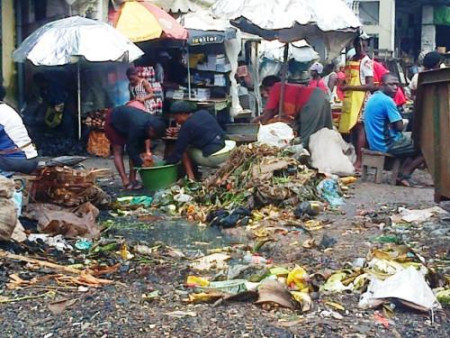
The mayor cited mixed results and a worsening sanitation crisis as reasons for the change. According to the official notice, the city faces persistent garbage piles in neighborhoods and along major roads. The reform aims to introduce a new waste management structure based on close community involvement.
A proximity-based model under Douala Clean City
Selected operators will collect waste directly from households and transport it to designated aggregation points under the “Douala Clean City” program, where the main collection service will take over. The city is targeting areas that are difficult to access with heavy trucks. Waste will be transported manually using wheelbarrows, pushcarts or tricycles.
Pre-collection routes will be defined neighborhood by neighborhood in consultation with residents. Schedules and collection frequency will also be agreed upon locally to adapt to specific constraints. The model operates on two levels: community-based pre-collection followed by centralized transport to treatment sites.
The document specifies that pre-collectors will be paid directly by beneficiary households. The CUD will provide logistical support but will not finance the service. In practice, the municipality is outsourcing the first stage of waste collection to users while retaining responsibility for final transport and treatment. The activities will cover all five districts of Douala.
A response to demographic pressure
The municipality links the reform to rapid urban growth. Official figures show Douala had about 1.9 million residents at the last census, a number now estimated at more than 4.3 million in 2025. Expansion into peripheral neighborhoods has outpaced infrastructure development, creating zones where heavy vehicles cannot circulate.
As a result, a significant share of waste remains outside the formal system. Each resident produces an average of 0.46 kilograms of waste per day, amounting to more than 700,000 tons annually. Around 150,000 tons are believed to be generated in areas difficult to reach through conventional collection. Currently, 65% of waste produced is collected, and there is no formal system for selective sorting, recycling or recovery.
In several neighborhoods, paid wheelbarrow-based waste removal already exists informally. The CUD is now seeking to formalize and organize the practice. The reform creates opportunities for small urban service firms and local associations, with potential for community-level job creation, while aiming to expand coverage in underserved areas.
Applicants must submit a file including a letter of interest, identification documents for individuals or legal documents for organizations, and a location plan. Expressions of interest must be submitted to the CUD registry service no later than March 12, 2026.
Amina Malloum
