





























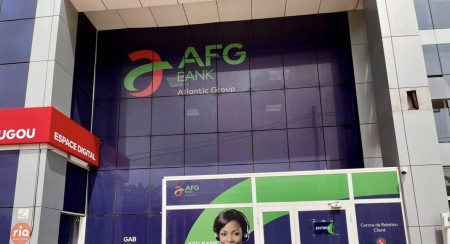
A review of Cameroon’s latest public debt situation report, covering the period up to end-September 2025, highlights the growing prominence of a banking player in managing the State’s domestic liabilities: AFG Bank. Through several receivables-purchase transactions, the institution has established itself as one of the key financial intermediaries mobilised to clear payment arrears owed by the central government to strategic enterprises.
Amid persistent pressures on public cash flow, the Cameroonian government has increasingly relied on a now well-established mechanism in 2025: the assignment of receivables. Under this arrangement, a bank purchases unpaid government invoices from suppliers, thereby converting floating commercial arrears into structured bank debt, which is recorded within the stock of domestic public debt.
The report published by the Caisse autonome d’amortissement (CAA) classifies these transactions under structured bank debt, a segment whose outstanding amount expanded significantly over the year. As of end-September 2025, central government domestic debt—excluding arrears payable and floating debt—stood at FCFA 4,246 billion, up 15.5% year-on-year. This trend reflects a stronger mobilisation of domestic financial resources to meet government financing needs.
AFG Bank takes over FCFA 50 billion in receivables
Within this framework, AFG Bank features prominently in the detailed tables on structured bank debt as the counterparty to several receivables-assignment agreements signed in 2025. An analysis of outstanding domestic debt, excluding arrears, highlights three foremost transactions attributable to the bank, totalling FCFA 50 billion.
This portfolio includes FCFA 30 billion corresponding to receivables purchased from independent power producer Globeleq, through its subsidiaries DPDC and KPDC. This is complemented by FCFA 10 billion linked to the takeover of receivables owed to the Port Authority of Douala (PAD), as well as an identical FCFA 10 billion tranche relating to commitments vis-à-vis Camtel, the state-owned telecommunications operator. These amounts appear simultaneously in the stock of structured debt and in effective disbursements, confirming that funds were effectively mobilised for the benefit of the entities concerned.
On its own, AFG Bank accounts for the vast majority of large-scale new receivables assignments recorded during the period. By comparison, other commercial banks are involved for smaller amounts. Société Générale Cameroun, Banque Atlantique Cameroun, CCA Bank and UBA mainly appear through legacy exposures from earlier operations or through individual transactions generally below FCFA 10 billion per agreement. This concentration of new operations around AFG Bank suggests a more assertive stance in refinancing government arrears, while other institutions appear to be focusing more on managing existing portfolios.
From a budgetary standpoint, these transactions reflect a recomposition of domestic debt. By replacing often long-standing and opaque supplier arrears with bank debt structured around defined repayment schedules, the government improves the visibility of its liabilities while easing liquidity constraints for strategic partners—particularly in the energy, telecommunications and port logistics sectors. This strategy is not without consequences. Structured debt now accounts for 26.2% of total domestic debt outstanding, up from a marginal share a few years ago, confirming a gradual shift towards more formalised financial instruments.
A banking position with noticeable sovereign exposure
For AFG Bank, this positioning increases its exposure to Cameroon’s sovereign signature. By absorbing these receivables, the bank places itself at the heart of the State’s financing circuit, within a framework of calculated risk, underpinned by formal agreements and government budgetary commitments. For public authorities, the benefits are twofold: avoiding financial distress among key suppliers and spreading the repayment of arrears over time, thereby easing pressure on budget execution.
Beyond the amounts involved, the recurrence of AFG Bank in receivables-assignment operations throughout 2025 sends a strong signal about the evolving management of domestic public debt in Cameroon. It illustrates the growing reliance on banking solutions to absorb public-sector liquidity rigidities, amid tighter budget discipline and closer monitoring of debt sustainability indicators. As of end-September 2025, Cameroon’s public debt stood at FCFA 14,591 billion, equivalent to 43.9% of GDP—a still manageable level, but one that conceals an internal rebalancing in favour of domestic bank debt.
Idriss Linge
