



























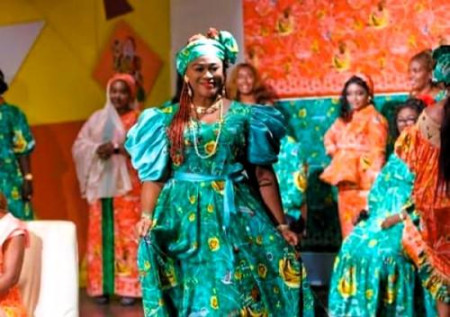
In 2026, the colorful fabrics sold across Cameroon for International Women’s Day were not made locally.
According to several sources familiar with the matter, the Industrial Cotton Company of Cameroon (CICAM), whose factory remains idle, once again outsourced production to the Indian group Oceanic. For the past four years, the state-owned company has relied on this foreign partner to secure supply during peak seasonal demand, mainly around March 8 and May 1.
Just over 2 million linear meters were produced and shipped to the Cameroonian market, roughly in line with 2025 volumes. Initial projections had targeted 3 million meters, against annual demand estimated at about 4 million. Oceanic reportedly scaled back production, citing economic and political uncertainty in Cameroon, according to an authorized source. Manufacturing began in November to account for shipping and customs clearance timelines.
CICAM’s management says overall demand was met, with stocks selling out in less than two weeks. No independent data is available, however, to verify the exact level of market coverage.
A Model That Preserves Sales but Costs Foreign Currency
The contractual setup reflects a shift in CICAM’s business model. The company retains responsibility for design, branding and domestic distribution. Oceanic acts as financier and supplier: it funds production, manufactures the fabric in its own factories and delivers finished cloth ready for sale.
After the sales cycle, CICAM repays the supplier and retains a margin, according to sources close to the matter. The exact financial terms — including production cost, margin levels, risk-sharing and any guarantees — have not been disclosed. Neither Oceanic nor CICAM has publicly commented on the contract.
For the state-owned firm, the immediate priority is no longer local manufacturing but maintaining a presence in a seasonal market that accounts for a significant share of annual revenue. Without this arrangement, several industry observers say CICAM would have struggled to supply the market during key periods.
Proceeds from these sales help cover what insiders describe as “minimum service” expenses: electricity bills, fixed operating costs and occasionally part of the wage bill. “Last year’s sales allowed the company to pay two months of salaries,” one internal source said.
The strategy carries a macroeconomic cost. It requires large-scale fabric imports and therefore foreign currency outflows — at odds with regional efforts within the Central African Economic and Monetary Community (CEMAC) to reduce external deficits and curb reliance on imports.
A Structural Crisis and Accounting Relief
CICAM’s crisis is not new. For more than a decade, the company has faced declining competitiveness, aging equipment, repeated production stoppages and cash-flow strain.
According to information obtained from sources close to the file, the company’s equity had fallen to levels that, under OHADA business law, exposed it to possible dissolution. To prevent that outcome, the Finance Ministry reportedly requested a revaluation of assets, including buildings and land.
The move lifted equity from negative CFA19 billion to positive CFA24 billion. But the improvement is largely accounting-based. CICAM still carries more than CFA35 billion in debt, according to several sources, weighing on liquidity and limiting any real investment capacity.
Restructuring Plans and Uncertain Negotiations
A diagnostic study commissioned by the Industry Ministry and conducted by Mazars estimates restructuring costs between CFA30.7 billion and CFA48.2 billion. A full state-led restructuring would require net financing of CFA40.6 billion. A partial privatization would reduce the need to about CFA21.7 billion. In either scenario, substantial capital injection appears unavoidable.
Since late 2024, the government has reportedly been negotiating with Arise Integrated Industrial Platforms (Arise IIP) for a potential equity stake. The group is said to be targeting about 85%, while the state aims to retain at least 30%, according to multiple sources. Talks have not yet produced a decisive breakthrough.
At the same time, a consortium including Panafritex — Arise’s textile arm — along with Sodecoton, the National Social Insurance Fund (CNPS) and Marlo Properties Fincorp, is preparing to launch Camtext SA. The planned CFA180 billion industrial platform in Dibamba would process 12,000 tons of Sodecoton cotton locally.
The project aligns with the government’s goal of raising domestic cotton processing to 50% by 2030, while current national production reportedly meets only about 5% of domestic demand.
In this shifting landscape, the partnership with Oceanic allows CICAM to remain visible in the market, but at the cost of domestic production. If Camtext moves forward, it could reshape the local textile industry and occupy industrial space the state firm can no longer sustain.
For now, CICAM continues to exist commercially without manufacturing. The situation raises broader questions about Cameroon’s import substitution strategy in the cotton-textile sector and the country’s ability to rebuild a durable industrial base.
Amina Malloum
