



















The CEMAC Commission is facing a sharp financial crisis as member states fail to fully transfer the Community Integration Tax (TCI), its main source of funding.
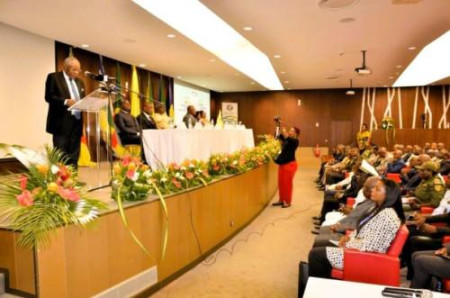
At a plenary session of the Community Parliament in Malabo on February 16, 2026, the Commission’s vice president presented the 2025 general report and described a break in financial stability. The TCI, the organization’s core resource, is not being regularly paid by member states, draining liquidity.
In 2025, of the CFA51.9bn expected, only CFA31.09bn was collected, a recovery rate of 59.9%. Cameroon and Gabon were the only countries to exceed the equal minimum contribution, while the other states made no payments.
As a result, arrears have climbed to CFA263.5bn, weakening the institution’s operational capacity and slowing integration projects.
Cameroon’s share of the outstanding balance stands at CFA59.9bn, or about 23% of total arrears. It ranks behind the Central African Republic (CFA61.8bn), but ahead of Congo (CFA52.2bn), Chad (CFA49.1bn), Equatorial Guinea (CFA34.1bn) and Gabon (CFA6.1bn).
The report calls for stricter enforcement of the autonomous TCI collection mechanism. “The strict implementation of the autonomous TCI recovery mechanism is a strategic imperative to ensure the Community’s financial sustainability,” it states, estimating potential mobilization between 45% and 55%.
Funding Bottleneck Slows Reform Agenda
Financing remains the main obstacle to the regional bloc’s mandate. “The financing of the Community remains the principal obstacle to the implementation of the Community mandate,” the report notes.
Persistent arrears, weak autonomous TCI collection and liquidity tensions have slowed many initiatives. The report warns that without full mobilization by member states, reforms will continue to lag behind political ambitions.
While some sectoral progress has been recorded, institutional capacity gaps and slow national implementation have limited impact. The Commission urges stronger coordination among states and a refocus on high-impact integration projects.
Emergency Measures to Preserve Cash
As liquidity deteriorates, the Commission has activated emergency measures. In a letter dated February 5, 2026, Commission President Baltasar Engonga Edjo’o announced the temporary suspension of activities and missions considered non-strategic. The goal is to maintain minimum operations while awaiting improved resource flows.
The TCI, applied at 1% on imports from third countries under the common external tariff, is designed as a dedicated resource to fund regional integration. In theory, it provides the Community with its own revenue stream. In practice, irregular transfers have weakened its financial architecture.
The report stresses that the bloc now has stronger institutions and clearer strategic frameworks, but that progress depends on effective implementation by community bodies and the political will of member states to apply decisions, provide financial support and take greater ownership of the integration project.
Amina Malloum
