






























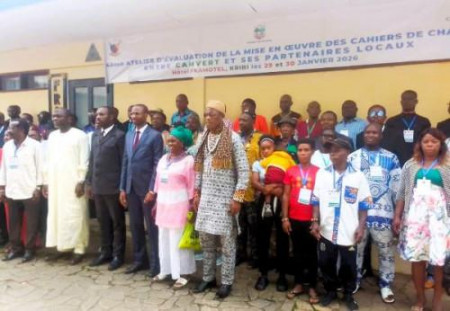
Camvert and several stakeholders in the municipality of Campo met in Kribi on January 29–30, 2026, for the fourth evaluation workshop on the implementation of social commitments linked to the oil palm agro-industrial project launched in the area in 2021. Participants included administrative authorities, local elites, and community representatives. The discussions focused on reviewing the 2025 action plan and validating the framework for the Campo Youth Socio-Professional Integration Fund.
CFA22 million announced, but governance still unclear
Documents reviewed indicate that 71 projects were preselected, with 17 ultimately retained for total financing of “nearly CFA22 million.” The supported initiatives include a catfish farming project, two artisanal fishing units, an office and photo services business, a mini cold storage facility, a beauty and aesthetics salon, and a plantain banana plantation.
However, several aspects of the mechanism remain unclear. The file states that the funds have already been set aside and that a dedicated account is to be opened in early February. Disbursements are expected to require three signatures, including that of a municipal representative and a member of a designated commission.
The financing is presented as repayable at 0% interest, under a repayment schedule that has yet to be defined, with the stated objective of enabling future rounds of support. Project holders will also be required to provide guarantees.
These elements raise public-interest questions, notably regarding the identity of commission members and the criteria for their appointment. Other issues include the nature of the guarantees required and the risk of excluding the most vulnerable youth. The modalities for tracking disbursements also remain unspecified, including whether beneficiary lists, amounts, repayment schedules, or audits will be made public. The repayable nature of the support further raises questions as to whether the scheme effectively operates as a microcredit mechanism, with procedures and sanctions for default still undefined.
Authorities warn against political capture
The meeting, chaired by senior divisional officer Luc Ndongo, representing the divisional officer, presented the fund as a “structuring” instrument, while warning that it should not become a tool for political capture. The warning underscored the importance of neutrality and transparency in allocating support in a sensitive local context.
Camvert cites progress on social commitments
Camvert Chief Executive Officer Mahmoud Mourtada said the workshop concluded that more than 75% of the social commitments planned for 2025 had been implemented. He cited maintenance work on the Lolabe–Campo road, boreholes, and school rehabilitation projects. He added that the fund’s resources would be available “in the coming days” through municipal accounts, which are expected to manage the disbursement.
The documentation also refers to 2025 activities including classroom rehabilitation and a birth registration campaign covering “more than 200 cases,” with a mobile court session held in Campo in September 2025. These claims, however, call for further verification through acceptance reports, field observations, beneficiary lists, dated photographs, and related procurement or technical documents.
Bagyeli training cited, but impact remains to be assessed
Regarding the indigenous Bagyeli population, the file indicates that seven young people are benefiting from training in tailoring, hairdressing, animation techniques, and community radio journalism, defined through participatory consultations with community leaders. The scope and impact of these programs remain to be assessed, including training locations, duration, trainer identities, employment outcomes, and post-training follow-up.
Albert Mboto Ndomi, presented as a social actor and promoter of a civil society organization involved in the project’s social and environmental components, said initial fears of clear-cutting and biodiversity loss had been mitigated by the environmental and social impact assessment and management plan. He nevertheless stressed that “not everything is perfect,” pointing to shortcomings that should be flagged to the company and calling for better alignment between local development and conservation in an area bordered by two protected zones.
Local elites call for stronger inclusion
Another local voice, Sylvestre Ngane, described as a Campo elite, said the project represented a “local asset” that should be sustained but argued that much remained to be done. He called for stronger engagement with local elites and specifically requested the creation of a human resources director position held by a local native, citing limited representation of local workers within Camvert.
Ludovic Amara
