


































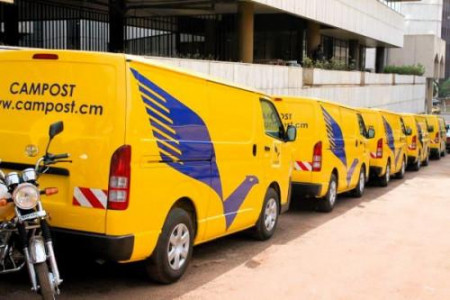
(Business in Cameroon) – The Cameroon Postal Services (Campost) is preparing a return to the e-commerce market. During the presentation of the budget for the Ministry of Posts and Telecommunications before the National Assembly, the minister announced the launch in 2026 of Bolamba, a new online shopping platform developed by the public postal operator. To support the initiative, Campost plans to set up two logistics platforms at the Douala and Yaoundé airports, on sites already allocated by the Cameroon Airports Corporation (ADC).
Investir au Cameroun reports that total investment is estimated at between CFA2 billion and CFA3 billion. The stated goal is ambitious: to make Cameroon a central African e-commerce hub. Bolamba will allow users to buy products on international sites such as Amazon. Parcels will be shipped to Cameroon through agreements with DHL, received at airports, then directed to recipients via post offices and Campost’s vehicle fleet, creating an integrated logistics chain.
This shift comes after the failure of the partnership signed in 2016 with Jumia. The arrangement aimed to strengthen the postal network and give people, including those in remote areas, access to platform products, with delivery times of 1 to 10 days and secure parcel tracking. “The collaboration did not last because Campost later felt it was doing most of the work and deserved higher payment. The two partners could not reach an agreement, and the contract was terminated,” sources said.
A high-potential niche
The Bolamba project is part of Campost’s modernization and digitalization strategy, intended to strengthen its resilience, bolster its role in the country’s economic development, and help it capture a promising market segment. According to Statista, the German data and statistics portal, Cameroon’s e-commerce market is valued at €811.09 million, or about CFA531 billion, in 2025.
To deploy the platform effectively, the national postal operator is relying on improvements to its addressing system and its network of 234 post offices nationwide. On November 1, 2024, Campost signed a strategic partnership with the Cameroonian start-up FindMe, already tested in Senegal, to adapt its model to the local context. The solution has been operational since July 2024.
Campost’s chief executive officer, Pierre Kaldadak, said at the time that the partnership with FindMe represents “a promising opportunity for our economy.” He said it fits with the company’s modernization plans. With the surge of e-commerce, he said, the postal service must reinvent itself to meet customer needs for last-mile delivery and to optimize its financial services through better identification of banking clients, in line with Know Your Customer (KYC) requirements.
Bolamba will expand a range of postal, financial, and digital services already being modernized. Beyond mail, parcel delivery, EMS, post office boxes, savings products, micro-credit, and insurance through CAMPOST Money, the company offers digital services such as videoconferencing, video surveillance, hosting, and e-post solutions. Bolamba aims to complete this ecosystem and reposition Campost as a central player in e-commerce and digital logistics in Cameroon.
The project also aligns with recommendations in the 2019 report of the Technical Commission for the Rehabilitation of Public and Parastatal Enterprises. The report noted that modernizing digital services and diversifying products should improve Campost’s operating performance.
Beyond the ambition
Despite the ambition, the Bolamba project raises several questions. Campost is entering the e-commerce market late, in an environment already shaped by private players who are more agile and more familiar with digital practices. The failure of the Jumia partnership, officially linked to payment disagreements, may also point to deeper challenges in building stable, balanced business models with the private sector.
The investment, estimated at CFA2 billion to CFA3 billion, is significant given the company’s financial situation. However, it remains modest if the goal is truly to make Cameroon a regional hub, with all the requirements in information systems, tracking, security, customer service, and last-mile logistics.
Heavy reliance on partners such as DHL for international shipping or a start-up for addressing capabilities also raises concerns. The question is whether Campost can control the entire value chain or whether it will remain a less competitive intermediary in a tight local and global market.
According to data presented by the prime minister as part of the economic and financial program, Campost generated CFA4.439 billion in revenue in 2024, up 30 % from the previous year. It is in this context of gradual recovery that the company is taking on the Bolamba venture: an opportunity to scale up, but also a crucial test of its ability to truly reinvent itself.
Amina Malloum
