




























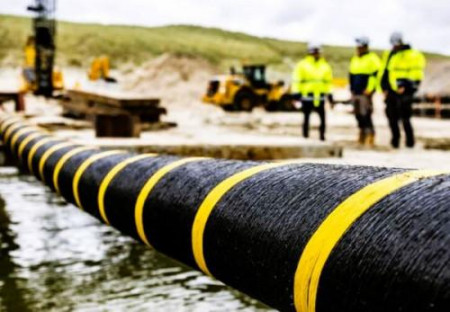
(Business in Cameroon) – Cameroon is moving ahead with its plan to connect to the Medusa Africa submarine cable, a next-generation system expected to reshape the country’s international connectivity, according to documents reviewed by Investir au Cameroun. The draft memorandum of understanding (MoU) has been finalized and submitted to the Presidency for “High Approval,” the first step before the State commits formally to the initiative. The projected cost for Cameroon’s contribution is estimated at CFA32.8 billion for the construction and operation of the new connection.
Medusa Africa is the West African branch of the broader Medusa Mediterranean system, led by AFR-IX Telecom Group, a Barcelona-based operator already present in Cameroon through a local subsidiary. Funded by the European Union, the cable is scheduled to be operational in 2028. It will link Southern Europe to the Maghreb and the Atlantic coast of Africa, with landing points planned in Dakar, Abidjan, Accra, Lagos, Kribi, Libreville, Luanda, and Cape Town. With Medusa, Cameroon will be connected to five international cable systems, alongside SAIL, WACS, SAT-3, and NCSCS.
Equipped with 24 fiber pairs per segment and offering between 10 and 18 Tbit/s per pair, Medusa is designed as an open, independent cable system capable of supporting Cameroon’s digital growth for at least 25 years. For Cameroon, it represents a critical replacement for the aging SAT-3 cable, whose capacity and maintenance have become increasingly costly. Unlike certain newer but unidirectional systems like SAT-3, Medusa provides multidirectional connectivity to Europe, North Africa, Southern Africa, and, through interconnections, Southeast Asia.
Strategic positioning
This expanded reach strengthens Cameroon’s ability to attract global platforms such as Google, Amazon, Microsoft, Meta, and Apple, all seeking new landing points to deploy cloud infrastructure and content-delivery services. Their arrival could drive foreign investment, create skilled jobs, and stimulate a new technology ecosystem around data centers and value-added digital services.
“Unlike CEIBA 2, NCSCS, and SAIL, which simply connect two countries without significant digital-economy impact, Medusa links Cameroon to South Africa, Europe, the Maghreb, and Southeast Asia, offering strategic multidirectional connectivity,” a source told Investir au Cameroun.
Beyond international connectivity, Medusa could establish Cameroon as Central Africa’s digital hub, providing increased international capacity, redundant routes to Europe, and a competitive advantage for connecting domestic data centers to global platforms. This shift could support the emergence of new services—local cloud, cybersecurity solutions, content-delivery platforms—while improving the resilience of existing systems (SAT-3, WACS, SAIL) through higher and more diverse traffic flows.
The system would also have fiscal implications. Medusa could create a new tax base built around high-value digital services, similar to models adopted in several European Union countries.
Challenges ahead
Success will depend on a renewed economic model combining an attractive cross-connect price for major international operators, effective interconnection between Cameroonian data centers and global infrastructure, and the development of high-value services such as local caching and cloud gateways. If the project receives final approval, the historical operator will need to optimize how this new cable is managed.
Camtel currently uses only 16% of the combined capacity of its four existing submarine cables, according to a June 2024 report by the Chamber of Accounts. Usage rates vary widely: 6% for SAIL, 57% for WACS, 29% for SAT-3, and 92% for NCSCS. This underutilization raises questions about the regional market’s ability to absorb new capacity and the operator’s commercial strategy.
Camtel’s management attributes this situation to the low Internet penetration rate in the sub-region, contrasting with earlier projections of rapid bandwidth demand growth. Management also points out that 83% of African Internet traffic is directed toward Europe, reducing the appeal of the SAIL cable and helping explain its low utilization. The arrival of Medusa could redirect flows and require a reconfiguration of traffic routes and commercial offers to fully capitalize on this strategic asset.
Amina Malloum
