


























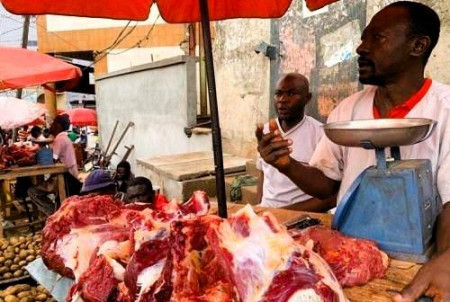
(Business in Cameroon) – Cameroon’s meat production is down again in 2025 after a 23% drop in 2024. In his general policy address on November 26 at the National Assembly, Prime Minister Joseph Dion Ngute announced total output of 172,910 tons for 2025. The figure is down 63,050 tons, or 36.46%, from the 235,960 tons recorded in 2024 by the Ministry of Livestock, Fisheries, and Animal Industries (Minepia).
This sharp decline over two consecutive years reflects weakened domestic supply, even as consumption needs remain high, with direct implications for markets and food security.
Cattle remains the leading segment with 68,902 tons of meat, followed by poultry (38,914 tons), pork (27,914 tons), goat meat (21,249 tons), and sheep meat (15,931 tons).
The decline is broad-based across all segments. It is especially strong in cattle, which fell by 25,398 tons in 2025 compared with 94,300 tons in 2024. This drop affects a key sector for both urban market supply and livestock farmers’ incomes.
The prime minister did not detail the causes of the overall decline in his address. However, industry actors point to degraded pastures and water shortages in the main cattle-producing areas of the Far North, North, and Adamawa regions.
Insecurity and cattle theft are also major constraints, weighing on herds and limiting production prospects. These combined risks weaken farmers’ ability to invest and slow herd rebuilding.
To counter these setbacks, the government and sector actors are pursuing several initiatives. The state plans to build the National Center for Animal Seed Production in Wakwa, in the Adamawa region. The facility is designed to produce more than 500,000 doses of bovine semen and 300 embryos per year to improve herd genetics and boost productivity.
Meanwhile, the Cameroon Interprofessional Council for the Cattle Industry (Cibovic), in partnership with Brazilian group Tace, is preparing to invest CFA128 billion in an ultramodern regional cattle market with a capacity of 20,000 head in Douala and Edéa, in the Littoral region. The project also includes plans to introduce 100,000 cows for insemination in Tcheré, Meïganga, Ngaoundal, and Touboro in the north.
These efforts combine market infrastructure, genetic improvement, and herd expansion, with the goal of stabilizing and eventually reviving the cattle industry and, more broadly, the meat sector.
Frédéric Nonos
