































-
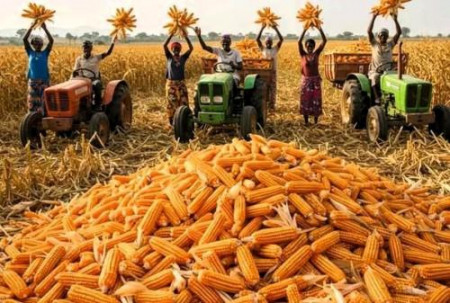
(Business in Cameroon) – Cameroon produces 2.2 million tonnes of maize annually while demand already exceeds 2.8 million tonnes.
-
Maize imports jumped 103% in 2024 to reach 81,833 tonnes, despite persistent informal exports of 50,000 tonnes a year.
-
Production costs reach CFA428,000 per hectare, while yields remain three times lower than global averages.
Maize remains Cameroon’s most cultivated cereal and a core pillar of national food security, yet the sector continues to operate under a structural deficit. The 2024 Competitiveness Report, published by the Committee on Competitiveness under the Ministry of the Economy, shows that demand has outpaced supply for years despite the crop’s central role in rural livelihoods. Households consume roughly 75% of production, and more than six million people depend on the maize value chain.
Cameroon produced an annual average of 2.2 million tonnes of maize from 2017 to 2021. Demand, driven by population growth and the expansion of agro-industrial sectors such as livestock, milling and starch processing, already reached 2.8 million tonnes in 2019. Demand continues to increase faster than domestic output, widening the deficit and weakening the trade balance.
Imports Surge While Informal Exports Persist
Pressure intensified in 2024. Cameroon’s maize imports reached 81,833 tonnes, up 103.1% year-on-year. Imports nearly tripled over five years, pushing the bill to CFA19.4 billion compared with roughly CFA8.5 billion in 2010. Argentina remains the main supplier.
The report highlights a paradox: despite rising imports, about 50,000 tonnes leak each year through informal cross-border flows to neighbouring countries. These outflows reveal dysfunction in domestic market organisation. They add to post-harvest losses, which reach 11% of production.
Cameroon posted an average maize yield of 1.8 tonnes per hectare in 2023, far below the global average of 5.9 tonnes and South Africa’s 6.4 tonnes per hectare. National production increases 2.2% per year, while population growth stands at 2.8%, which deepens the deficit.
The report links weak performance to a farming model dominated by small family plots with low mechanisation and limited access to inputs. It notes that “the direct production cost of one hectare of maize is estimated at around CFA428,000,” a figure inflated by poor availability of certified seeds, fertilisers and proper drying and storage infrastructure.
A Push to Modernise the Sector
To reverse the trend, the Committee on Competitiveness calls for rapid modernisation of the sector through the development of large-scale farms capable of leveraging economies of scale. The report urges the country to strengthen seed systems, encourage hybrid varieties adapted to local conditions, promote mechanisation and invest in modern storage facilities.
It also emphasises the need to expand access to agricultural finance to support producers throughout the production cycle. With domestic demand rising sharply, policymakers view these reforms as essential to reducing external dependence and positioning the maize sector as a long-term driver of food sovereignty and economic competitiveness.
This article was initially published in French by Amina Malloum
Adapted in English by Ange Jason Quenum
