






















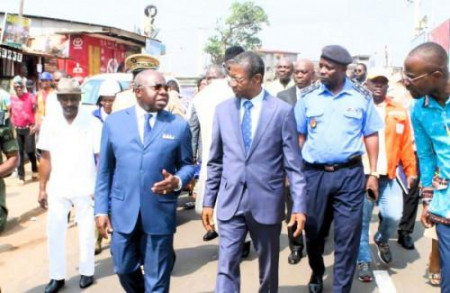
(Business in Cameroon) – The Minister of Decentralization and Local Development, Georges Elanga Obam, told lawmakers on July 3 that the government has stepped up efforts since 2018 to strengthen the financial capacity of decentralized local governments (CTDs), including municipalities and regions. From 2019 to 2024, he said, “the state’s overall financial effort reached CFA2 312 billion, including CFA828 billion from tax transfers and CFA1 483 billion in grants.”
Under Article 12 of the General Code of Decentralized Local Governments, adopted in December 2019, transfers to CTDs take the form of tax revenues, grants, or a mix of both to support their assigned responsibilities. According to the Ministry of Finance, public resources allocated to CTDs in 2021 totaled CFA232 billion, of which CFA106 billion was for investment and CFA125 billion for operating expenses.
Financial Transfers Continue to Grow
The General Decentralization Grant (DGD) has expanded in recent years. In 2022, it reached CFA240 billion, including CFA128 billion for operations and CFA112 billion for investment. In 2023, the total increased to CFA252 billion, with CFA115 billion for investment and CFA137 billion for operations. A Finance Ministry document on the 2025 budget states that, “overall, during 2021–2023, the DGD grew by CFA20 billion, a 9 % increase.”
Transfers continued to rise afterward. According to the Permanent Secretariat of the National Decentralization Council, attached to the Prime Minister’s Office, “resources dedicated to decentralization increased again in 2025, with CFA303 billion transferred, compared with CFA292 billion budgeted in 2024. This represents an absolute increase of CFA10 billion and a relative increase of 3.6 %,” said its secretary, Evelyne Koa-Otsili Medzogo.
Government communication on decentralization accelerated after 2021, when the DGD expanded sharply. Research by Vincent De Paul Essomba shows that in 2010, the first allocation to CTDs was CFA9.6 billion. It rose gradually to nearly CFA50 billion in 2020 before jumping to CFA232 billion in 2021. Over the past seven years, the state has disbursed more than CFA852 billion under this mechanism.
A Complex Funding System
Decentralization is also financed through tax transfers. Municipal levies and local taxes feed into CTD budgets through the Special Fund for Inter-Municipal Equipment and Intervention (FEICOM), often described as the “bank” of local governments. According to the Ministry of Finance, fiscal revenues collected by FEICOM and redistributed to CTDs reached CFA327 billion in 2021, CFA387 billion in 2022, and CFA362 billion in 2024.
These flows are supplemented by the local taxation law that took effect in January 2025. According to the minister, “for regions, the implementation of their dedicated taxes should generate about CFA118 billion. For municipalities, expected additional collections amount to about CFA101 billion.”
These figures do not include funding tied to the actual transfer of responsibilities from central administrations to CTDs, which increases the total envelope. As Koa-Otsili Medzogo noted, “when combined with the financial resources for competencies not yet effectively transferred—such as staff in basic and secondary education, youth, health, arts, and culture—the total amount dedicated to decentralization financing for 2025 reaches CFA958 billion.”
Still Far From the 15 % Requirement
Despite the rise in allocations, the government remains below the minimum threshold required by law. Essomba notes that “Article 25 of the 2019 General Code of CTDs stipulates that the DGD cannot be less than 15 % of state revenues. Yet in 2021, the allocation represented only about 7 %.” Although the DGD has increased since then, it still falls short of the legal target.
The 2025 state budget illustrates the gap. Total spending exceeds CFA7 700 billion, with revenues of about CFA4 000 billion. Applying the 15 % requirement would mean transferring CFA600 billion to CTDs. In reality, the budget provides CFA303 billion, or 7 % of revenues.
Within the government, officials admit that stabilizing and expanding CTD resources remains a structural challenge. “The main challenge is to substantially increase CTD resources by raising state grants (especially the DGD), improving local tax performance, and reorganizing the equalization system. The issue is effective implementation of the local taxation law,” Minister Elanga Obam told lawmakers.
Finance Minister Louis Paul Motaze signaled that reaching the 15 % benchmark is not likely soon. During the November 2025 budget session, he argued that “there was a misunderstanding when the 15 % threshold was adopted. Some simply applied the rate to the state budget and said ‘we want that amount.” He stressed that the DGD does not take precedence over debt service to international lenders or the sequence of transferring competencies. “Resource transfers follow the transfer of competencies. CTDs were already expecting the 15 % while competencies had not yet been transferred,” he said.
Ludovic Amara
