































Cameroon is pursuing a 640,000-tonne cocoa production target by 2030 through farm intensification rather than forest clearance, with the Cocoa and Coffee Development Fund (FODECC) mapping nearly 400,000 plots to prove zero encroachment on protected woodland.
The Japan International Cooperation Agency (JICA) visited FODECC headquarters in Yaounde on February 4, to study the fund’s financing model for sustainable cocoa, which combines agricultural intensification with forest protection in the Congo Basin.
JICA’s mission leader for nature conservation in the Congo Basin said the visit aimed to learn from FODECC’s experience with sustainable cocoa challenges, structural partnerships, and international cooperation dynamics to inform a future landscape restoration project. The agency is developing an initiative focused on climate change mitigation and adaptation across agriculture, forestry, and land use sectors.
IMF-backed climate financing model
FODECC’s administrator highlighted the fund’s involvement in high-level climate discussions with the International Monetary Fund and its partnerships with international bodies, particularly the Central African Forest Initiative (CAFI). He presented the Pilot Project for Sustainable Intensification and Agroecological Transition (PAIDATA), which finances cocoa and coffee sectors whilst preserving forest ecosystems.
EU deforestation compliance underway
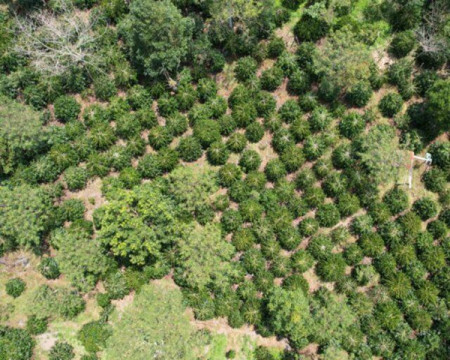
The fund has launched an extensive geolocation and traceability programme to comply with the European Union Deforestation Regulation (EUDR). FODECC has registered 360,000 producers and nearly 400,000 plots, with targets to reach 500,000 of each by the end of 2026. Through partnership with the Technical Centre for Forestry and Cooperation (CTFC), agricultural plot data is overlaid with classified forest maps to ensure zero encroachment on permanent forest areas.
Mapping work has revealed plantation under-density, with current levels at 600 trees per hectare against the recommended 1,100. FODECC has identified redensification as a key lever for increasing yields without expanding cultivated areas. Research and grafting techniques are being deployed to regenerate old orchards and improve disease resistance.
640,000-tonne target by 2030
The initiatives support Cameroon’s national objective of reaching 640,000 tonnes of cocoa production by 2030. According to FODECC, the most recent cocoa season recorded an additional 17,000 tonnes. The FODECC model demonstrates how developing nations can align agricultural expansion with international climate commitments and forest preservation requirements whilst accessing global markets under increasingly stringent environmental regulations.
Mercy Fosoh
