





























- (Business in Cameroon) – NHPC revenues are projected at €207 million (CFA135.7 billion) in 2025 and €208 million in 2026.
- NHPC invoices Eneo CFAF 10 billion monthly regardless of actual consumption, under its concession terms.
- The government is negotiating a CFA80–100 billion revolving guarantee to secure NHPC payments as Eneo faces liquidity stress.
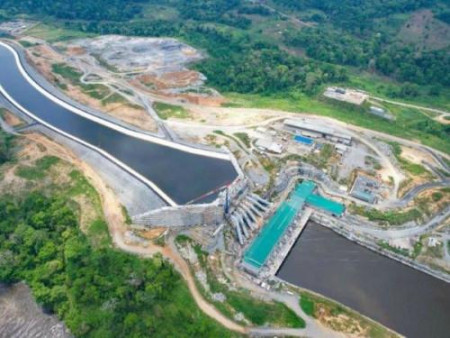
Nachtigal Hydro Power Company (NHPC), operator of Cameroon’s 420-MW Nachtigal hydropower plant, is expected to post significant revenue growth over the next two years, according to a Finance Ministry report. The ministry projects NHPC revenues at €132 million (CFA86.5 billion) in 2024, €207 million (CFA135.7 billion) in 2025 and €208 million (CFA136.4 billion) in 2026.
The ministry does not detail the drivers of the increase. NHPC derives all of its income from electricity sales to Eneo, its sole client. Since the progressive commissioning of the plant’s seven turbines, NHPC has invoiced Eneo CFA10 billion per month, regardless of whether the utility consumes all the energy produced. This arrangement, set out in the state-negotiated concession, ensures predictable revenues and shields NHPC from hydrological or demand fluctuations. “In low-water periods, the Lom Pangar upstream reservoir supplies us with minimum flows,” NHPC officials say.
Despite the plant’s technical ramp-up, part of its available power remains unabsorbed. Delays in constructing transmission lines, particularly the line connecting the Nyom substation to Yaoundé, continue to restrict Eneo’s capacity to evacuate energy. To resolve the bottleneck, the government plans to build a second high-voltage “corridor” to absorb additional volumes, including output from Nachtigal. The extension will enable the connection of new industrial clients from 2026, with an estimated 150 MW of potential load representing about CFA50 billion in additional revenue.
In this context, the Finance Ministry is negotiating with Société Générale Cameroun and several domestic banks to establish a new financial guarantee to secure NHPC’s payments. Documents reviewed by Business in Cameroun show the operation involves a revolving credit line of CFA80–100 billion.
This initiative comes as Eneo faces acute liquidity shortages. The utility has been unable to meet its contractual obligations since February. It was required to provide a bank guarantee against non-payment, backed by a sovereign guarantee, but failed to secure financing. As a result, NHPC activated its existing guarantee with Société Générale Paris. That initial guarantee covered €86 million (about CFA56 billion), but more than 85% has been used, leaving less than €10 million available.
Following the renationalisation of Eneo, the government is preparing a full recovery plan to be completed by 2026. The plan includes a diagnostic and restructuring roadmap by February 2026, as well as a debt reorganisation. A new mechanism to reinforce the recovery of public-sector arrears is also expected before 2026 to ease financial pressure on the utility.
According to the Energy Ministry’s Compact Energy Country Report, Eneo’s total debt stood at CFA800 billion at the end of 2024, including CFA500 billion owed to suppliers and CFAF 80 billion in receivables. The ministry lists Eneo as a major fiscal risk to the state. Internal documents describe the utility as “a factor likely to cause gaps between budget projections and execution” due to its deteriorating financial position and a high risk of payment default.
Amina Malloum
