






















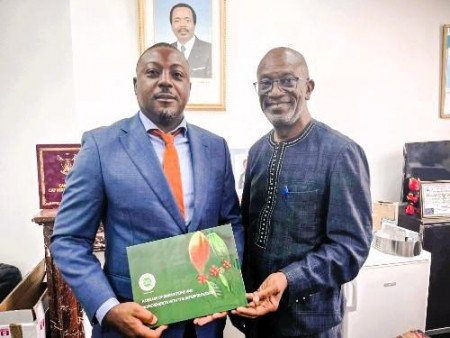
(Business in Cameroon) – Omer Maledy, Executive Secretary of Cameroon’s Interprofessional Cocoa and Coffee Council (CICC), and Fabris Ekeu, General Manager of GS1 Cameroon, signed a memorandum of understanding (MoU) on Oct. 9, 2025, to enhance traceability in the country’s cocoa and coffee sectors. GS1 is the global standards organization behind barcodes.
The agreement seeks to speed up Cameroon’s compliance with the European Union Deforestation Regulation (EUDR), which bans exports to Europe of agricultural and forestry products , including cocoa, coffee, rubber, palm oil, soy, beef, and timber , sourced from deforested land.
The partnership ensures full traceability and data compliance across Cameroonian supply chains, placing the country among the leaders in sustainable, transparent trade that meets EU standards.
Building on geolocation mapping already conducted by the CICC, producers, cooperatives, and exporters can now link their location data to GS1 Global Location Numbers, allowing standardized, direct interoperability with European data platforms. Each shipment will also carry a GS1 container code, enabling traceability of origin and composition even for blended products.
Ekeu said the data will be automatically synchronized , including EUDR attributes such as origin, GPS coordinates, and DDS ID , within the CICC’s global network and connected European systems.
According to the signatories, the system improves data reliability, ensures full interoperability with European databases, lowers compliance costs, and safeguards market access for exporters.
At the National Forum on EUDR Compliance held in Yaoundé on July 15, 2025, Trade Minister Luc Magloire Mbarga Atangana said that 99% of Cameroon’s cocoa and coffee growing regions were already covered by geolocation and traceability systems.
The EUDR, initially due to take effect on Jan. 1, 2025, was postponed to 2026 and may now be delayed again to 2027. In a Sept. 23, 2025, letter, EU Environment Commissioner Jessika Roswall attributed the latest delay to the IT platform’s inability to handle the expected data volume.
The extension gives Cameroon more time to prepare its rubber, palm oil, soy, beef, and timber sectors for compliance. Cocoa and coffee are especially strategic: Cameroon, the world’s fifth-largest cocoa producer, exports 78% of its cocoa and 87% of its coffee to the European Union.
Frédéric Nonos
