




























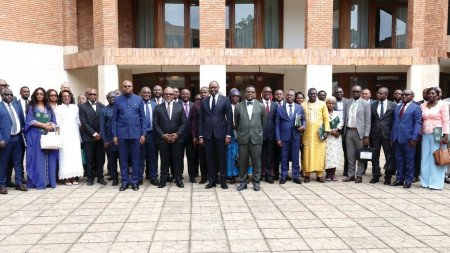
(Business in Cameroon) – Cameroon has officially launched the national process to integrate the new CEMAC directive on public-private partnerships (PPPs). The initiative follows a workshop held on 9 December 2025 in Yaoundé, chaired by Paul Tasong, Minister Delegate to the Minister of the Economy, Planning and Regional Development in charge of planning. The session marked the formal start of activities to transpose the regional text into domestic law.
Adopted on 25 February 2025, the directive aims to create a harmonised legal and institutional framework for designing, awarding, and managing PPP contracts across the Central African Economic and Monetary Community. It establishes standard procedures, clarifies the role of each actor and aims to create a predictable environment for investors across the region. Under CEMAC rules, member states must transpose the directive into their national legislation, generally within 12 to 18 months.
A Reform Meant to Strengthen PPP Governance in Cameroon
Although Cameroon has had a PPP law since 2006 and an implementing decree since 2016, the national framework has long been considered outdated and out of step with current financing needs. Procedures have been fragmented, project preparation has been weak, and transparency has been inconsistent, making it difficult for large infrastructure programmes to progress. The transposition of the CEMAC directive is therefore not only a legal requirement but also an opportunity to modernise a system that struggles to mobilise investment and ensure credible project oversight.
One of the most significant aspects of the reform involves the repositioning of the Council for Support to the Realisation of Partnership Contracts (CARPA), the technical body responsible for PPP development. CARPA has historically faced operational challenges, including insufficient resources and unclear authority relative to sector ministries and the Ministry of Finance. The new directive provides a more precise definition of CARPA’s mandate in project screening, risk analysis, contract standardisation and monitoring. Strengthening this institution is widely viewed as essential to improving the credibility and efficiency of PPP processes.
The directive is also expected to improve transparency and investor confidence at a time when Cameroon’s access to traditional borrowing is becoming more constrained. Governments across CEMAC increasingly view PPPs as an alternative means of financing infrastructure in sectors such as roads, energy, water, health and urban development. However, investors continue to seek stronger contractual stability, more precise risk-allocation mechanisms and more predictable fiscal commitments. While the directive represents progress, observers note that it does not yet offer solutions to fully address the impact of counterpart-fund requirements on public debt, an issue regularly highlighted by lenders such as the World Bank and the African Development Bank.
The scope of the directive covers all economic sectors, except oil, gas, mining, defence, security, and projects requiring confidentiality. It focuses the PPP framework on civilian infrastructure and public-service-oriented investment. The text also expands PPP typologies, including a new non-concessive urban-development model applicable to local development plans, housing policies and the development of economic-activity zones. Its implementation is expected to affect several significant projects in Cameroon, including the Edéa–Kribi highway, regional hospital PPPs, urban redevelopment programmes in Douala and Yaoundé, and renewable-energy and water-treatment initiatives. Improved governance and clearer standards could help unlock delayed investments and ease access to both concessional and private financing.
Speaking during the workshop, Paul Tasong emphasised the importance of ensuring that all actors share a common understanding of the directive’s provisions. He recalled Cameroon’s responsibility, as a CEMAC member, to preserve the community’s achievements, including the stability of the Central African CFA franc. For his part, Pierre-Guillaume Boum Bissai, CEMAC’s resident representative in Cameroon, highlighted the region’s considerable infrastructure deficits across transport, energy, telecommunications, digital services and healthcare. The World Bank estimates the annual financing gap at around 2,500 billion FCFA. Limited budgetary capacity and a shallow regional financial market make it difficult for states to fund essential projects, further underscoring the need to mobilise private capital.
With the launch of the transposition process, Cameroon positions itself to align its national legislation with CEMAC’s broader economic strategy to boost investment, strengthen fiscal coordination, and address significant infrastructure gaps across Central Africa. Successful implementation, however, will depend on institutional reform, particularly the effective empowerment of CARPA, stronger inter-ministerial coordination, and the adoption of clearer, investor-friendly procedures.
Mercy Fosoh, Edited By Idriss Linge
