










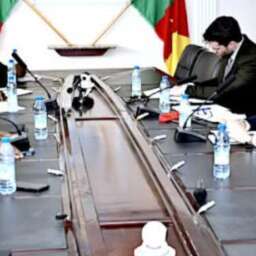








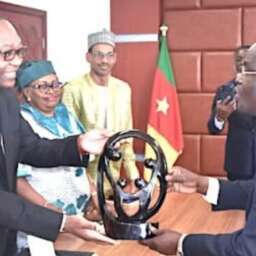


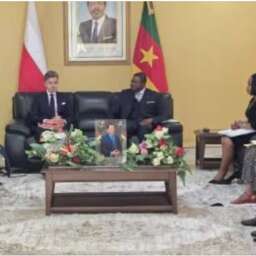



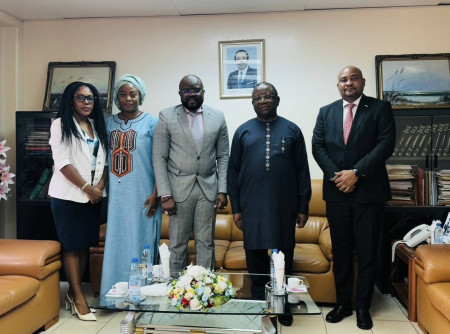
Cameroon’s Minister of Trade, Luc Magloire Mbarga Atangana, has confirmed the government’s support for the implementation of a trade facilitation project linked to the African Continental Free Trade Area (AfCFTA), presented by the International Organisation for Migration (IOM). The assurance was given on 23 December 2025 in Yaounde, during a meeting with Abdel Rahmane Diop, Head of Mission of the IOM in Cameroon, marking a further step in Cameroon’s project-based approach to AfCFTA operationalisation.
The initiative targets two of Cameroon’s most strategic trade corridors, Douala–Bangui and Douala–Kousseri, which link the port of Douala to landlocked Central African and Sahelian countries. These axes are critical for regional trade and transit but remain constrained by weak border governance, security challenges and high transaction costs. The project aims to improve cross-border trade flows and strengthen economic resilience in sensitive border zones by promoting closer transnational cooperation and better coordination among administrations operating along the corridors.
Valued at 2,252,354 Units of Account, or approximately FCFA 1.8 billion, the project is financed primarily through a grant of 2,000,000 Units of Account from the African Development Bank, complemented by a contribution of 252,354 Units of Account from the IOM. The programme focuses on improving data collection related to mobility and trade, supporting local economic development and financial inclusion, strengthening border governance, and ensuring effective project management and monitoring. Particular emphasis is placed on small-scale cross-border traders, women and youth, who play a central role in informal trade along these routes.
According to the IOM, the project is designed to support Cameroon’s national AfCFTA implementation strategy while strengthening the capacities of public administrations and technical services responsible for border and corridor management. It also seeks to integrate migrant communities and the diaspora into local economic systems, reflecting the growing recognition of the structural links between migration, trade and regional integration.
The initiative builds on discussions dating back to 2022, when the Minister of Trade highlighted the need to better manage trade corridors amid increased mobility and deeper economic integration. At the December 2025 meeting, Mbarga Atangana reiterated the government’s commitment to facilitating the project’s execution, stressing its consistency with AfCFTA objectives and the World Trade Organisation’s Trade Facilitation Agreement. While modest in scale, the project underscores Cameroon’s reliance on donor-funded operational programmes to address concrete bottlenecks in cross-border trade, as the country seeks to translate continental trade ambitions into practical outcomes on the ground.
Mercy Fosoh
