



























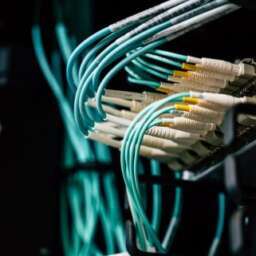



Cameroon’s President has authorised the Minister of Economy, Planning and Regional Development to sign a loan agreement with the Export-Import Bank of China to finance the expansion of the country’s fibre optic backbone, according to a decree dated 6 March 2026.
The loan amounts to 1,350,963,161.10 Chinese yuan, equivalent to approximately 108.39 billion CFA francs, and will fund Phase IV of the fibre optic backbone expansion. It is intended to strengthen telecommunications transmission capacity across the country.
This expansion is part of Cameroon’s wider infrastructure investment programme, which includes telecommunications and digital connectivity projects aimed at supporting economic activity, public administration services and private sector development.
It adds to the government’s ongoing financing efforts aimed at supporting infrastructure development and expanding the country’s telecommunications backbone network.
Cameroon’s public debt reached 14.24 trillion CFA francs at the end of 2024, representing roughly 45.6% of GDP, according to the country’s Autonomous Sinking Fund (CAA). The increase followed a 7.8% rise in government borrowing during the year, mainly linked to public investment and budgetary financing needs.
The new borrowing comes as the International Monetary Fund (IMF) continues to rate Cameroon at high risk of debt distress. In its 2026 Article IV consultation mission completed in February 2026, the IMF projected the country’s fiscal deficit at 1.7 per cent of GDP for the year, with growth forecast at 3.3 per cent, while noting that near-term financing pressures remained elevated, prompting external commercial borrowing.
According to IMF data, Cameroon’s gross government debt is projected at 38.56 per cent of GDP in 2026. The Fund has repeatedly called on Yaounde to prioritise concessional financing for infrastructure and to expand non-oil revenue mobilisation to contain debt vulnerabilities.
Data from the World Bank indicates that Cameroon’s general government debt stood at around 43.4% of GDP by the end of 2024, with external debt accounting for roughly 29% of GDP and domestic debt about 14.4%.
Regional rules set by the Central African Economic and Monetary Community (CEMAC) place a 70% of GDP ceiling on public debt levels for member states. Cameroon’s debt ratio remains below that threshold.
Mercy Fosoh
