
























(Business in Cameroon) – In August 2025, the government of Cameroon quietly activated its CFA200 billion sovereign guarantee facility, created in 2021, to help three private companies obtain a combined CFA26.9 billion in financing from the Development Bank of Central African States (BDEAC). The information appears in the public debt report for the end of September 2025.
“It is worth noting that on August 19, 2025, the BDEAC signed three financing agreements guaranteed at 50 % by the State, with private companies, for a total amount of about CFA26.9 billion. These loans were granted to the following companies: LP Industrie S.A (CFA8.9 billion), Groupe Sohaing SAS (CFA15 billion), and Camas S.A (CFA3 billion),” reads the document from the national sinking fund (CAA), the public debt manager. In practical terms, to encourage BDEAC to fund these projects — building a rebar plant (LP Industrie SA), constructing a high-end hotel (Groupe Sohaing), and acquiring 23 trucks along with building a logistics base (Camas SA) — the State agrees to assume half of the default risk.
This means the Treasury commits to repaying 50 % of each BDEAC loan on behalf of the beneficiary if the company faces repayment difficulties. This government initiative strengthens the creditworthiness of the borrowers by reducing the lender’s exposure, thereby making BDEAC more willing to grant the requested funding.
A guarantee facility reformed for greater effectiveness
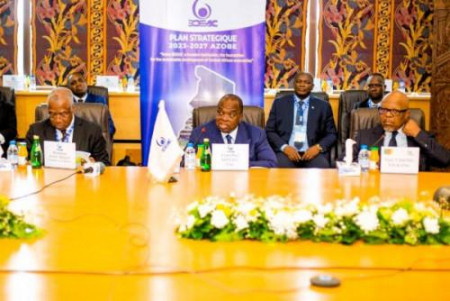
The sovereign guarantee granted to the three private companies stems from a portfolio guarantee agreement signed on December 20, 2023 in Douala between Finance Minister Louis Paul Motazé and BDEAC President Dieudonné Evou Mekou. The signing took place on the sidelines of a General Assembly of the subregional financial institution in Cameroon’s economic capital.
This agreement materializes the commitment made by the State of Cameroon to support public and private companies seeking funding, through a CFA200 billion guarantee facility introduced in the 2021 finance law. Implemented starting in 2022 with mixed results, according to the Ministry of Finance, the mechanism was revised in 2023 to improve efficiency.
Under the revised mechanism, 30 % of the CFA200 billion guarantee envelope is allocated to support access to credit for public enterprises, and 70 % for private sector companies. Coverage rates under this facility—reserved exclusively for Cameroonian companies with majority Cameroonian capital—are capped at 30 % for large companies and 70 % for SMEs.
Priority for investments aligned with the SND30
However, these coverage ceilings can rise to 60 % for large companies and 80 % for SMEs operating in economically distressed zones. These include the North-West, South-West, and Far North regions, affected respectively by the Anglophone crisis and Boko Haram attacks.
Eligible loans under the State facility include working capital financing and investments in sectors identified as priorities in the National Development Strategy 2020-2030 (SND30): energy, financial services, agro-industry, digital, wood, textiles-garments-leather, mining-metallurgy-steel, hydrocarbons-petrochemicals-refining, chemicals-pharmaceuticals, construction, and services.
“Also considered priorities are loans aimed at increasing local production of major imported goods and strengthening Cameroon’s export capacity. Excluded from this scope are refinancing, restructuring, repayment, or buyback operations for existing loans,” Secretary-General of the Ministry of Finance Gilbert Didier Edoa said on August 16, 2023 in Yaoundé. He made the remarks during a presentation of the revised mechanism to bankers, at the signing of a portfolio guarantee agreement between the Ministry of Finance and the Association of Credit Institutions of Cameroon (Apeccam).
