
























Africa spends roughly $50 billion a year importing cotton products that it could manufacture itself, Afreximbank President George Elombi said, outlining a continent-wide industrialisation strategy at the 14th World Trade Organisation Ministerial Conference in Yaounde.
The plan, presented to more than 166 ministers and policymakers gathered in the Cameroonian capital for the first WTO ministerial on African soil since Nairobi in 2015, aims to replace raw cotton exports with local processing capacity across multiple countries.
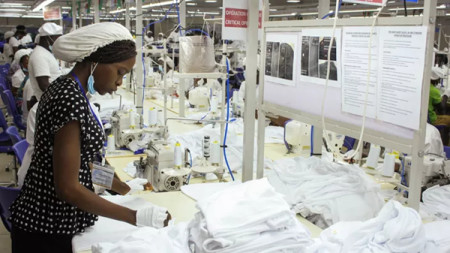
At the centre of the strategy is a model already deployed in Benin. According to Elombi, the country previously exported 40,000 tonnes of raw cotton annually at between $1 and $1.50 per kilogramme, generating roughly $40 million in export revenue. Processing that same volume within Benin’s special industrial zone, where one kilogramme of cotton yields approximately four T-shirts retailing at $45 each, has pushed annual export earnings to around $800 million.
Afreximbank is now scaling that approach. Together with its industrial partner Arise Integrated Industrial Platforms, in which the bank holds more than 35% ownership, it has begun constructing dedicated cotton-processing special economic zones in Cameroon, Chad, Côte d’Ivoire and Mali. Discussions are ongoing with Kenya, Rwanda and Nigeria, where committed investment stands at $2 billion.
The long-term objective is to eliminate raw cotton exports from Africa entirely within 15 to 20 years. By 2030, the programme is expected to generate 500,000 jobs and $10 billion in annual exports.
To address investor concerns, particularly around energy, water, transport and logistics, the bank is embedding core infrastructure directly within the industrial zones. “Where the gas is required, we will install the pipelines, and where connecting roads and transport infrastructure are needed, we will work with governments to develop them,” Elombi said.
Each zone will also include African Quality Assurance Centres to certify products against international standards before export, reducing reliance on destination-country testing. Financing for processors will be channelled through the bank’s trade and distribution company. Afreximbank currently holds $11 billion in liquid cash assets on a $50 billion balance sheet, which it expects to reach $56 billion by year-end.
Elombi used the WTO platform to argue that the current multilateral trade system has failed to support Africa’s industrial ambitions. “The time has come to rethink the multilateral system that has not served Africa so very well,” he told delegates.
He also warned that governance bottlenecks could undermine the programme’s success, citing delays at seaports and in construction permitting, which he said should not take six months for industrial zone licences.
Beyond domestic constraints, Elombi raised concerns about global trade dynamics, arguing that WTO principles alone do not adequately protect Africa’s emerging manufacturing base from subsidised competitors. “Fairness is sometimes not about equality of treatment, but it is about bringing others to the right level playing field,” he said.
To support implementation, Afreximbank is working with export credit agencies in China and Switzerland to mobilise financing, while alignment with the new leadership of the African Development Bank is expected to accelerate delivery. The bank is majority-owned by African governments and institutions, which hold more than 75% of its shareholding.
Mercy Fosoh
