























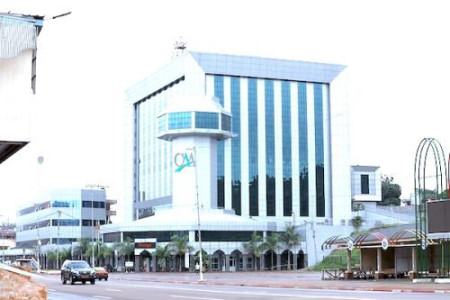
At the end of March 2026, Cameroon’s debt stock stood at CFA15.4 trillion, or 44.3% of GDP, according to the national sinking fund (CAA). That level remains well below the Cemac region’s 70% debt ceiling and under Cameroon’s own medium-term target of 50% of GDP.
Fitch Ratings reinforced that relatively stable picture on April 24, when it affirmed Cameroon’s sovereign rating at “B” with a negative outlook. The agency pointed to steady economic growth and manageable debt maturities, while also warning about weak liquidity conditions, public finance management challenges, and rising domestic payment arrears.
But the headline debt ratio no longer tells the full story.
The bigger concern increasingly lies in the government’s ability to manage cash flow, honor payments on time, absorb already-approved financing, and prevent persistent liquidity stress from weakening the country’s financial position.
In other words, the issue is no longer just how much Cameroon owes. It is also about how the state manages a growing web of obligations sitting outside the traditional debt stock.
Those exposures include public-private partnership (PPP) commitments, undisbursed financing already contracted by the state, unpaid government bills, debt carried by state-owned companies, and loans transferred from the government to public entities.
These obligations are not all the same. Some represent immediate payment obligations. Others involve financing agreements that have been signed but not yet disbursed. Still others are contingent liabilities that could materialize only if certain guarantees are triggered or public entities run into financial trouble.
That distinction matters because the issue is not necessarily one of “hidden debt.” Rather, it reflects a growing accumulation of financial commitments that complicate the state’s liquidity position and blur the true scale of budgetary risk.
PPPs: infrastructure today, fiscal pressure tomorrow
One major area of concern is Cameroon’s growing reliance on public-private partnerships. According to the CAA, the government’s explicit contingent liabilities — largely tied to PPP projects — totaled CFA4.9 trillion at the end of March 2026, or about 14.1% of GDP. That figure does not include the planned Cameroon-Congo railway project, whose estimated cost alone stands at CFA5.4 trillion.
These commitments are not yet considered direct public debt. But they could eventually generate real budget costs if public guarantees are activated, project revenues disappoint, or the financial structure of the projects weakens.
For years, PPPs were promoted as a way to finance infrastructure without immediately increasing public debt ratios. But their long-term impact depends heavily on project governance, contract design, and the government’s ability to manage associated risks.
As liquidity pressures grow, those obligations are attracting closer scrutiny.
Undisbursed financing raises execution concerns
Another indicator drawing attention is the level of undisbursed committed financing, known locally as SEND.
At the end of March 2026, Cameroon’s central government had CFA5 trillion in signed but undisbursed external financing commitments, including CFA246.3 billion in budget support.
These funds are not immediately payable debt. But they raise questions about the state’s ability to turn signed financing agreements into actual disbursements and completed projects.
The issue is less about solvency than execution.
Projects delayed by weak absorption capacity often become more expensive over time and push financial obligations further into future budget cycles. In that sense, SEND levels reveal operational weaknesses in public investment planning and implementation rather than immediate debt distress.
Unpaid bills are hitting companies directly
Pressure on public finances becomes more visible through government payment arrears.
The CAA estimates unpaid government obligations at CFA1.03 trillion, including CFA452.5 billion overdue by more than three months. The institution notes that the figure still reflects estimates from December 2025 while updated payment data is being consolidated.
Unlike contingent liabilities, these are bills the government already owes but has not yet paid.
For businesses working with the state, the effects are immediate: cash shortages, project delays, postponed investments, heavier reliance on bank financing, and rising commercial risk tied to public contracts.
In a February 2026 presentation on Cameroon’s liquidity crisis, Treasury Director Samuel Tela said average government payment delays had stretched from around 120 days in 2023 to more than 200 days in 2025.
According to Tela, the situation has evolved beyond temporary cash mismatches and become a structural liquidity problem fueled by rising financing costs, weak domestic liquidity, rigid spending obligations, and weaknesses in budget management.
He pointed in particular to overly optimistic revenue projections, underbudgeted expenditures, and persistent disconnects between spending commitments and actual payment capacity.
Debt service is consuming state revenues
Another sign of mounting pressure is the growing weight of debt servicing on government finances. According to Tela’s presentation, debt service now absorbs 52.6% of the state’s own revenues.
The figure highlights a broader reality often overlooked by debt-to-GDP ratios: a country can maintain moderate debt levels while still facing severe liquidity stress if mandatory payments consume too much of its available cash. That pressure is also becoming visible in Cameroon’s domestic debt market.
Tela noted that yields on 26-week Treasury bills, which stood around 3.5% before the liquidity squeeze, have climbed closer to 7%. Some government debt auctions have also struggled to attract enough investor demand.
The figures come from a Treasury presentation rather than a full market dataset, but they point to a clear trend: refinancing is becoming more expensive and investors more selective.
For the government, that means higher borrowing costs. For the broader economy, it risks crowding out private sector financing as banks and investors channel more resources toward state borrowing.
State-owned companies remain another source of risk
Cameroon’s broader public sector also adds to sovereign exposure.
Debt held directly by public companies and institutions reached CFA960 billion at the end of March 2026. In addition, the state has transferred CFA825 billion in loans to 11 public entities to finance 43 separate projects.
These obligations do not automatically become Treasury liabilities. But they represent indirect sovereign exposure, especially if financially fragile public companies require state support to maintain operations.
Taken together, the data does not point to an immediate debt explosion.
Instead, it paints the picture of a country whose debt ratios remain below key warning thresholds, but whose fiscal position is becoming increasingly strained by liquidity pressures, unpaid obligations, contingent exposures, and a more demanding domestic financing environment.
That is now the core issue facing Cameroon’s public finances.
The country’s risk profile no longer depends only on the debt it officially reports. It also depends on the obligations sitting around that debt — the payments delayed, the guarantees extended, and the state’s ability to convert borrowing into productive assets without further weakening its liquidity position.
Baudouin Enama

