


























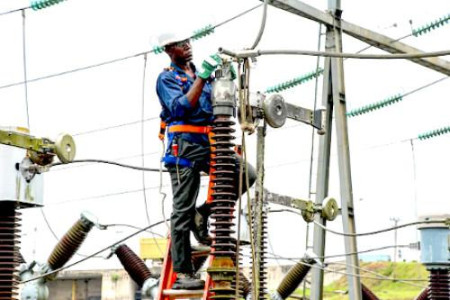
Cameroon’s government is considering a 15% increase in electricity tariffs for low-voltage business customers whose monthly consumption exceeds 220 kWh, according to a restructuring plan for former utility operator Eneo, now renamed Socadel.
The plan, drafted in March 2026 by the Ministry of Water and Energy (Minee) and reviewed by Investir au Cameroun, was presented on April 28 to financial partners in the electricity sector, including lenders involved in the Nachtigal hydropower project, during a meeting at the Ministry of Finance.
Electricity rates for low-voltage customers in Cameroon have remained unchanged since 2012, despite rising production, energy purchase and operating costs over the past 13 years.
According to the document, the tariff freeze has significantly increased the compensation payments the government must provide to the sector. Those subsidies reached CFA79 billion in 2025 and are projected at CFA39 billion in 2026. The report also points to a structural monthly deficit of CFA13 billion for Eneo.
Minee says the proposed increase would help reduce pressure on public finances while supporting the financial recovery of the operator. The ministry argues that the 15% adjustment would still remain below cumulative inflation since 2012, framing it as a partial correction rather than a full alignment with the actual cost of electricity service.
By 2028, the government expects the measure to generate about CFA8.7 billion in additional monthly revenue.
The increase would apply only to professional customers with energy-intensive equipment. Households would not be affected, according to the report. Small businesses and low-consumption professional users — including small garages, beauty salons, clinics and neighborhood shops — would also be excluded.
“This adjustment will not affect small consumers such as small garages, small beauty institutes, small health centers and small shops. Households will also not be affected by the measure,” the report states.
Part of a Broader Pricing Shift
The proposed increase is part of a broader effort to gradually align electricity prices with the real cost of service in Cameroon.
Since 2023, the Electricity Sector Regulatory Agency (Arsel) has been adjusting high- and medium-voltage tariffs. According to a source familiar with the matter, those reforms generated CFA9 billion in additional cash flow in 2023 and CFA10 billion in 2024. In 2026, further adjustments in those segments are expected to add about CFA750 million in monthly revenue.
Since January 1, 2024, medium-voltage customers — mainly industrial users — have already faced higher electricity prices. That category represents about 2,000 customers out of more than 2 million subscribers in Eneo’s customer base, or roughly 0.1% of total clients.
In an information note reviewed by the publication, Eneo said the increase would reach 5% for consumption brackets between 0 and 3 MW and 10% for those between 3 and 10 MW.
Unclear Timeline
The timing of the proposed increase for low-voltage business customers remains uncertain.
The Minee document projects additional monthly revenue by 2028, suggesting the measure would be phased in gradually rather than applied immediately across the board. So far, authorities have not announced an implementation date, billing structure or possible appeal mechanisms.
The restructuring plan says any tariff adjustment would also need to be matched by improvements in service quality.
That remains a major issue for businesses.
According to projections cited in the report, the SAIDI index — which measures the total annual duration of power outages per customer — would improve from 51.5 hours to 45.8 hours by 2027. The SAIFI index, which tracks outage frequency, is expected to decline from 20.1 to 18.3 interruptions per customer annually over the same period.
Still, concerns about electricity reliability remain widespread in the private sector.
Célestin Tawamba, president of the Cameroon Business Group (Gecam), said 80% of member companies identify electricity shortages as their main operational challenge. He blamed repeated outages and unstable supply despite increases in generating capacity.
“We operate in an environment marked by power rationing and poor electricity quality,” he said.
A Broader Recovery Plan
The proposed tariff increase is presented as one of the main pillars of the restructuring plan for former operator Eneo.
Combined with new industrial connections, anti-fraud measures, recovery of public-sector debt and debt refinancing, the reform is expected to eliminate most of the operator’s CFA13 billion monthly deficit by the end of 2027.
The document also notes that the sector continues to face pressure from Cameroon’s VAT proration mechanism, which prevents the operator from fully recovering taxes paid on certain purchases. The government compensates that shortfall each year at an estimated cost of about CFA10 billion annually.
According to the report, validated compensation payments totaled CFA28 billion as of December 31, 2024, with another CFA8.8 billion awaiting approval as of October 31, 2025, leaving CFA36.8 billion still outstanding.
To address the issue, the restructuring plan proposes introducing a zero-rate VAT policy in Cameroon’s 2027 finance law for electricity consumption between 0 and 220 kWh. Officials say the measure would permanently remove that burden from the operator.
Amina Malloum

