



















The Governor of the Bank of Central African States (BEAC), Yvon Sana Bangui, has categorically ruled out any devaluation of the CFA franc, dismissing persistent rumours circulating across the CEMAC sub-region as unfounded, analytically flawed, and in some cases deliberately misleading.
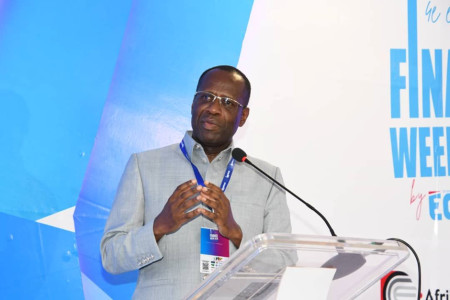
Speaking at the fourth edition of Finance Week in Yaounde, the flagship economic forum convened annually by business intelligence publication EcoMatin, Sana Bangui used his keynote address to confront head-on what he described as a two-year pattern of alarmist speculation threatening financial confidence across six member states: Cameroon, Gabon, the Republic of Congo, Chad, the Central African Republic, and Equatorial Guinea.
The BEAC Governor’s rebuke was unusually direct. He acknowledged that voices, some carrying a degree of authority, others wholly anonymous, had been calling for a currency devaluation with growing frequency, citing economic indicators he said bore no relation to verified data.
“Those calling for devaluation on the basis of partial, approximate, and frankly I would say malicious analyses, I say no. Devaluation is not on the agenda. Not in 2024, not in 2025, not in 2026, not in 2027. The rumours are totally unfounded,” Sana Bangui told the assembly of bankers, industrialists, financial operators, and policymakers.
The Governor insisted that all economic indicators published by BEAC, covering inflation, growth rates, foreign exchange reserves, and public debt, are rigorously collected, independently verified, audited, and aligned with international standards derived from established macroeconomic models.
The data behind the defiance
The denial carries weight at a moment when the CEMAC zone’s fiscal position is showing measurable improvement. According to BEAC projections presented at Finance Week, the sub-region’s budget deficit is forecast to narrow sharply to 2.2 per cent of GDP in 2026, down from 4.8 per cent in 2025, a contraction of more than half in a single year. The figure had already attracted the scrutiny of the International Monetary Fund at its 2025 peak.
The macroeconomic tableau, drawn from BEAC’s official slide deck presented at the event, showed CEMAC GDP growth projected at 2.9 per cent for 2026, with inflation contained at 2.3 per cent, below the sub-regional convergence threshold. Public debt stands at 49.8 per cent of GDP, well under the 70 per cent community ceiling.
Foreign exchange reserves, which recorded a steep decline in 2025 linked to debt servicing obligations and elevated imports, are projected to recover to 4.52 months of import cover by the end of 2026, rising further to 4.70 months by 2027.
Banking sector: Stable but structurally fragile
Away from the currency debate, BEAC’s data disclosed notable vulnerabilities within the sub-regional banking system. The sector counts 54 active institutions with a combined balance sheet of 27,535 billion CFA francs an 11.7 per cent annual increase. Deposits reached 19,065 billion CFA francs, partly driven by repatriation of oil revenues, while outstanding loans stood at 13,998 billion CFA francs.
According to the Governor’s presentation, 18 banks currently lack sufficient capital to meet all applicable solvency standards. Bank exposure to sovereign risk loans to governments reached 10,641 billion CFA francs at end-2025, the highest level in five years and equivalent to 5.2 times the sector’s aggregate own funds. Non-performing loans stand at 16 per cent, more than three times the five per cent threshold. Some 70 per cent of the population remains outside the formal banking system.
Diversification gains
Sana Bangui pointed to one encouraging structural shift: economic growth across Central Africa is increasingly driven by non-oil sectors.
“It is important to highlight that growth in Central Africa and this is good news, is being driven by non-oil sectors: agriculture, construction, digital services. This shows that our economy is gradually diversifying,” he said.
The BEAC chief nonetheless acknowledged that the current account deficit is projected to widen to 5.2 per cent of GDP in 2026, driven by deteriorating terms of trade and rising imports. Geopolitical tensions stemming from the Iran-Israel-United States conflict, which has pushed the oil price approximately 40 per cent higher to around 100 dollars a barrel since February 2026, could compound inflationary pressures and strain import bills further.
The road ahead: reform or risk
BEAC’s own scenario analysis presented at the event set out the cost of inaction starkly. In the absence of structural reforms, the fiscal deficit could balloon to 4.1 per cent of GDP in 2026, reserves could fall to just 3.1 months of import cover by 2027, and the current account shortfall could deteriorate to 6.3 per cent of GDP.
The Governor called on member-state governments to maintain budgetary consolidation, honour the commitments made at the January 2026 CEMAC Heads of State summit, and improve compliance with sub-regional convergence criteria. He urged private sector operators to mobilise investment in productive sectors and to comply with export revenue repatriation rules.
“We are working today to restore our framework, improve our macroeconomic trajectory and strengthen the resilience and soundness of our banking institutions. All actors; finance ministers, planning ministers, institutions at the sub-regional level, we are working, and we are transforming all our challenges into opportunities,” Sana Bangui told reporters.
Finance Week 2026, held under the theme: “Private Investment: Building the New Economic Power of the CEMAC,” brought together banking executives, industrial operators, financial sector representatives, and political authorities from across Central Africa.
Mercy Fosoh

