





























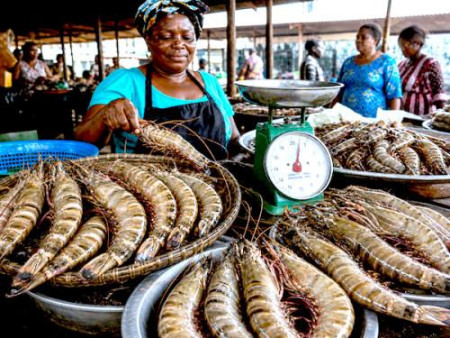
Cameroon’s shrimp industry, the country’s leading fisheries export, remains constrained by widespread informality, post-harvest losses, a weak cold chain and limited access to high-value international markets, a study conducted under the FISH4ACP program shows.
The study, developed alongside an economic model for the National Veterinary Laboratory (LANAVET), estimates that the sector involves more than 11,000 direct participants, including 4,085 fishers, around 3,500 traders, 200 transport operators, about 100 processing units and roughly 10 export companies. It generates an estimated $47 million in added value and accounts for about 12% of the fishing sector’s GDP. Artisanal production is put at 6,002 tonnes per year.
A high-potential sector, but poorly structured
One of the study’s key findings relates to participation in shrimp fishing. Nigerian fishers account for 61.5% of active fishers in the segment. While this does not mean they control the entire value chain, it shows that Cameroonian fishers are not the majority at this critical stage of production.
This imbalance adds to another structural issue: the dominance of informal activity. According to the study, 84% of traders operate outside the formal economy, while 86% of profits are captured by industrial firms and wholesalers, pointing to a sharp imbalance in value distribution.
Informality limits traceability, complicates market organization and weakens regulatory oversight. It also restricts access to finance, with only 3% of fishers able to obtain formal credit.
Three channels and significant outflows to Nigeria
The study identifies three main distribution channels: local markets account for 50% of transactions, national markets 30%, and exports 20%. Export flows are split between formal shipments to Asia — notably China, Malaysia and Vietnam — and informal trade with Nigeria.
Ndian illustrates these structural gaps. The study estimates that 58% of production in the area is diverted to Nigeria, largely due to the absence of cold storage infrastructure in Bakassi. As a result, part of the output moves through poorly monitored channels, complicating quality control, taxation and traceability.
More broadly, the sector reflects a persistent gap between resource potential and the capacity to preserve, market and add value to production.
More than CFA 4 billion in annual losses
Losses begin early in the chain. The study estimates that poor storage conditions lead to annual losses exceeding CFA 4 billion. It reports that 88% of fishers cite a lack of ice as a key cause of spoilage, 89% of processing units report losses before unloading, and 75% of local transport operators use no refrigeration equipment.
These figures highlight the cold chain as a critical bottleneck. In a sector where sanitary quality determines market access, the lack of ice, cold storage and appropriate equipment significantly reduces product value.
Cameroon’s shrimp industry thus faces a paradox: it produces a high-value resource — notably gamba shrimp, prized for its large size and quality — but remains constrained by basic infrastructure gaps.
European market still closed
Regulatory barriers further limit export potential. The study notes that the European market has been closed to Cameroonian shrimp since 2009 under EC Regulation No. 146/2009. It also points to the “yellow card” issued by the European Union in 2021 over illegal, unreported and unregulated fishing.
The report adds that a national control laboratory exists but is not operational. Once functional, it would be critical to certifying compliance with international sanitary standards, particularly for the EU and U.S. markets.
Governance is also fragmented. Seven ministries are involved in the sector without a formal coordination framework, a situation that risks delaying reforms at a time when traceability, sanitary compliance and anti-IUU measures are key to accessing higher-value markets.
Reform priorities
The study outlines several priorities. It calls for investment in cold chain infrastructure at landing sites, including ice plants, shared cold storage facilities and solar-powered solutions for remote areas. It also recommends creating a one-stop shop to improve access to financing, technical support, training and markets.
Formalizing the sector is another key priority. This would require making the national control laboratory operational, strengthening sanitary standards, promoting hygiene practices and establishing an inter-ministerial coordination framework.
The adoption of Law No. 2024/019 of Dec. 23, 2024 — the first legislation specifically addressing fishing and aquaculture — marks a step forward. Its impact will depend on effective implementation, reduced informality and improved control of commercial flows.
Ultimately, the sector’s weakness lies not in a lack of resources but in the failure to build an efficient value chain. The priority is not to increase catches, but to improve preservation, strengthen regulation, enhance traceability and ensure that local operators capture a larger share of the value generated.
Ludovic Amara

