























Cameroon has presented its water and energy investment prospects to international financiers and partners during the Spring Meetings of the International Monetary Fund and the World Bank in Washington, with ministers outlining a coordinated strategy to boost growth, attract capital and accelerate industrialization.
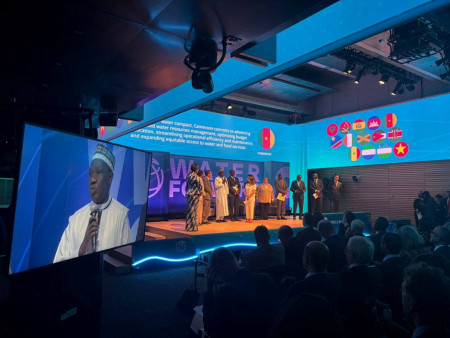
The Minister of the Economy and the Minister of Water Resources and Energy took part virtually in key sessions held between April 15 and 17, 2026, where they promoted ongoing reforms and sector opportunities. The engagements included the launch of the global “Water Forward” initiative and a high-level roundtable focused on energy and industrial development.
At the Water Forward launch on 15 April, Cameroon joined a coalition led by the World Bank Group, multilateral development banks and development finance institutions. The initiative aims to improve water security for one billion people by 2030 through stronger coordination between public policy, financing and partnerships. It is designed to position water systems as drivers of economic growth, employment and resilience.
“Water is fundamental to the functioning of economies. When water systems work, farmers produce, businesses operate, and cities attract investment. Our task now is to align reform, financing, and partnerships to deliver reliable water services at scale,” said Ajay Banga, President of the World Bank Group.
Cameroon used the platform to highlight its National Water Compact, currently being rolled out as a strategic framework to structure reforms, improve governance and mobilize public and private financing. Authorities indicated that the initiative is intended to expand access to drinking water, accelerate hydraulic infrastructure investment and align national policies with international standards.
“For Cameroon, this approach reflects a commitment to strengthen access to potable water, accelerate investment in water infrastructure and align national policies with international standards. It also opens the way for stronger partnerships with donors and the private sector,” the Ministry of Water Resources and Energy stated.
Beyond water, the country positioned energy, particularly natural gas, as central to its economic transformation agenda during a roundtable held on April 17. The joint participation of the Ministry of the Economy and the Ministry of Water and Energy underscored a policy shift framing energy as a core pillar of national competitiveness and industrial capacity.
Officials highlighted that energy availability directly influences business competitiveness, investment attractiveness and the ability to process natural resources locally. Gas, in particular, was presented as a cross-cutting solution to stabilize electricity supply, support industrial activity and expand access to clean cooking for households.
Current production stands at approximately 1.5 million tons in 2025 from two operating gas fields, compared with proven reserves estimated at 6.16 trillion cubic feet. Authorities indicated that scaling up exploitation could reduce vulnerability to hydrological shocks through gas-to-power solutions, support industrialization via gas-to-industry projects and improve household energy access through domestic gas development.
The Washington engagements are part of a broader effort to translate resource potential into bankable projects, with a focus on aligning reforms, financing mechanisms and partnerships. By linking water security and energy expansion to economic outcomes, Cameroon is positioning both sectors as strategic levers for growth, job creation and long-term resilience.
Mercy Fosoh

