




























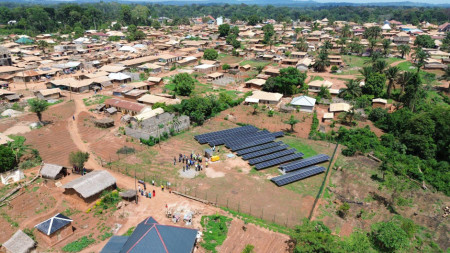
Cameroon has switched on its first privately operated solar mini-grid under the National Energy Compact, commissioning, on April 22, a 100 kilowatt-peak (kWp) photovoltaic installation in the village of Voundou, in Mbangassina, Mbam and Kim Division of the Centre Region. The project, built, owned, and operated by local firm Renewable Energy Innovators Cameroon (REI Cameroon), puts the country’s third energy compact pillar: distributed renewable energy, into commercial operation for the first time and sets a replicable template for electrifying the more than 9,000 Cameroonian villages that remain without grid power.
With a storage capacity of 116.6 kWh and a distribution network linking homes, health centers, commercial premises, and a service station, the plant is designed to supply more than 100 subscribers in Voundou immediately, with expansion to 300 kWp already planned.
Government figures presented at the commissioning ceremony showed Cameroon’s overall electrification rate stands at about 74%, while access in rural areas remains below 40%. Authorities say this imbalance has made decentralized systems such as solar mini-grids a priority under the National Development Strategy, NDS30.
Nkué said the state had invested heavily in major energy assets including Kribi gas plant, Lom Pangar dam, Memve’ele hydro scheme, Nachtigal hydropower project and solar facilities in Maroua and Guider, but many communities still remain distant from transmission networks.
“The national grid is very expensive to develop across the entire territory. Developing mini-grids is a form of complementarity to current energy policy. Mini-grids are necessary to supply communities that are far from the national electricity network. This project falls directly in line with the current government energy policy and the Energy Compact, which is now the reference framework for public action,” Nkué said.
He added that solar generation would complement, not compete with, existing hydro and thermal sources as part of a broader national energy mix.
REI Cameroon eyes 145-village rollout
For REI Cameroon, the Voundou site is both a commercial pilot and a proof of concept for a wider expansion strategy. Chief executive Jude Numfor said the company aims to deploy 145 mini-grids across six regions by 2029, although he noted this would still cover less than 1% of more than 9,000 villages nationwide said to lack electricity access.
The company said the Voundou project cost about CFA200 million and could later be expanded from 100 kW to around 300 kW as demand grows. That scalability could make mini-grids attractive to investors seeking long-term exposure to Cameroon’s off-grid power market.
“The project demonstrates clearly that renewable energy solutions in Cameroon are not only impactful but also bankable,” Numfor said.

Locally built, digitally monitored
The plant’s technical configuration combines a 100 kWp solar field with a 116.6 kWh battery storage system and three inverters a 50-kilowatt primary unit and two complementary 12-kilowatt inverters, all manufactured and assembled locally in Cameroon. A diesel generator provides backup reliability, ensuring power is available by 7:30 am regardless of solar irradiation conditions.
The site is equipped with real-time remote monitoring software and surveillance cameras, allowing REI Cameroon engineers to track system performance and respond to faults via a mobile application from any location. The distribution network connects households, health centers, commercial outlets, and public institutions, with circuit-breaker protection at the central distribution point.
For Njemsi Emmanuel Kimah, a Voundou entrepreneur who has already connected five woodworking machines, ranging from seven to ten horsepower to the grid, the commissioning marks the end of a costly dependence on generators and fuel scarcity. He said that since connecting to the mini-grid he had experienced no power failures, could run all his machines simultaneously for the first time, and had reduced physical strain while increasing output capacity.
“Formerly I had to run my machines one by one with a generator. Now we work like other people in town and I expect more output. We no longer feel we are behind from others. Even in Yaoundé people sometimes lose power, but here we don’t lose power,” Njemsi said.
Why Voundou matters
The Voundou project offers a commercial test case for decentralized rural electrification in Cameroon. If tariffs remain affordable and collections stable, the model could unlock fresh private capital for similar schemes nationwide.
For the government, each successful village mini-grid may reduce pressure on expensive grid extensions while accelerating progress towards its 2030 electricity target. For businesses such as REI Cameroon, the opening creates a foothold in what executives describe as a large untapped market for distributed power.

With thousands of communities still lacking reliable electricity, Voundou’s new solar plant is an early test of whether private mini-grids can drive rural economic transformation in Cameroon.
Numfor used the platform to set out the conditions he believes must be met if Cameroon is to replicate the Voundou model at scale. He called for improvements in the regulatory framework, including streamlined site identification, allocation, and authorization processes to reduce project development timelines and costs. He also identified the need for investor risk-mitigation instruments, including guarantees, targeted subsidies, and blended finance structures, to unlock the private capital required.
Mercy Fosoh

