



























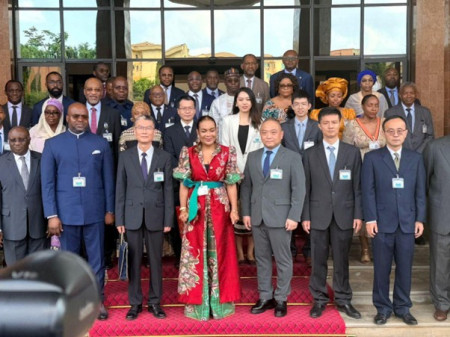
Cameroon’s National Hydrocarbons Corporation (SNH) hosted, Thursday, April 16, a Chinese embassy delegation in Yaounde, with discussions centered on advancing investment-linked energy projects and industrial expansion in the Kribi zone. The recent meeting brought together SNH officials and the newly appointed Economic and Commercial Counsellor of China, Xiao Guofeng, as part of a working visit focused on strengthening bilateral economic cooperation.
The talks focused on ongoing large-scale developments in the Kribi industrial-port area, including the CSTAR project to build a refinery and petroleum storage depot, alongside the expansion of the KEDA ceramic tile manufacturing plant. SNH, which supplies natural gas to the KEDA facility, positioned these projects as key anchors for industrial growth, with implications for downstream value addition and energy security. The engagement also covered upstream opportunities, with emphasis on attracting investment into exploration and production activities. The discussions further addressed technology transfer mechanisms, workforce capacity development, and the promotion of locally produced goods.
According to information made public by SNH, Adviser No. 2, Nathalie Moudiki, representing the Executive General Manager, commended the excellent relations of friendship and cooperation between Cameroon and China. She further reaffirmed SNH’s commitment to supporting initiatives aimed at strengthening investment and promoting mutually beneficial partnerships in the hydrocarbons sector.
The CSTAR refinery, backed by SNH, Tradex, and Ariana Energy, carries a total investment value of $622 million and is projected to generate $250 million annually in marine and petrochemical exports once fully operational. At initial capacity of 10,000 barrels per day, one-third of its planned 30,000 bpd ceiling, the refinery is expected to cover roughly 22% of Cameroon’s national diesel and gasoline demand, significantly reducing the country’s dependence on imported refined fuels. Once fully operational, the facility is projected to cut fuel imports by nearly one-third, easing pressure on foreign exchange reserves.
According to the latest project schedule, front-end engineering design studies are to be completed by June 2026, equipment delivery is planned for September 2026, and initial production is targeted to begin around December 2026, nearly two years ahead of the original June 2028 commissioning date.
On the KEDA front, SNH supplies gas via a 6km pipeline to the KEDA facility, the largest ceramics plant in Central Africa which upon full commissioning will consume up to 6 million cubic feet of gas per day and produce approximately 20 million square meters of ceramic tiles annually, meeting roughly two-thirds of domestic demand. The project is expected to create approximately 2,000 direct and indirect jobs in the Kribi region, underpinned by a 20-year gas supply agreement.
The meeting comes against a backdrop of deepening bilateral economic ties. Trade between Cameroon and China exceeded CFA1,600 billion in 2024, including CFA1,100 billion in Cameroonian imports, according to the National Institute of Statistics. Cameroon nonetheless continues to post a significant trade deficit with China, estimated at CFA714.3 billion in 2023, up 18.5%, according to a report by Business in Cameroon. In December 2025, the two countries signed a framework agreement in Yaounde aimed at expanding market access, including potential duty-free entry for Cameroonian goods into the Chinese market.
The Yaounde engagement reflects ongoing efforts to align energy sector investments with industrial output growth, particularly within the Kribi corridor, which has been positioned as a central hub for export-oriented manufacturing and petroleum processing.
Mercy Fosoh

