































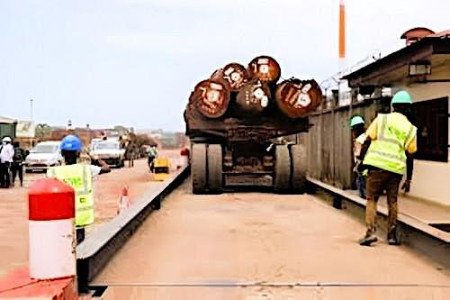
Cameroon is revising its strategy to modernize four road weigh stations after a partial failure of a procurement process launched in 2025.
During a meeting held on April 13, 2026, in Yaoundé, Public Works Minister Emmanuel Nganou Djoumessi outlined a new acquisition approach for the stations of Mandjou (East), Manwi (Adamaoua), as well as Bekoko and Njombe (Littoral).
The shift follows a national tender issued in August 2025 for the rehabilitation of these facilities, with a budget of CFA520 million. At the end of the process, contracts for Bekoko and Njombe were awarded to a single company, while bids for Mandjou and Manwi were declared unsuccessful.
The outcome raised concerns within the Ministry of Public Works, notably the risk of contract concentration and the insufficient quality of some proposals.
To address these issues, the government now plans to split the contracts more finely, separating civil works from technical equipment. The objective is to widen competition, encourage greater participation from specialized local firms, and improve both execution quality and delivery timelines.
Preparations to relaunch the tender are already underway, according to the ministry.
This new attempt forms part of a broader effort to digitize the country’s 17 weigh stations, a project announced more than a decade ago but still incomplete.
On the ground, the current system continues to face operational challenges, including power outages, recurring equipment failures, limited infrastructure, and frequent disputes with transport operators.
The reform also carries fiscal implications. Regulations provide for fines ranging from CFA25,000 to CFA75,000 per excess ton, along with mandatory offloading. In 2020, these penalties generated around CFA2 billion in revenue for the public treasury.
However, transport unions argue that this figure remains below potential, citing persistent manual intervention in operations, which creates room for informal practices and corruption.
By reducing human intervention, the planned digitalization is expected to streamline operations, improve transparency, and strengthen revenue collection.
Frédéric Nonos

