























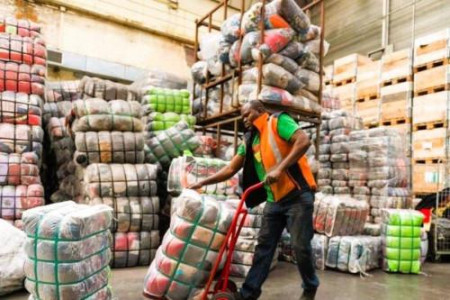
Cameroon imported 73,008 tons of used clothing—including garments, shoes, and accessories—in 2025, for a total cost of CFA42.5 billion, according to the National Institute of Statistics (INS) in its latest foreign trade report. The figure marks an increase of CFA2.6 billion compared with 2024, when imports stood at CFA39.8 billion for 72,600 tons.
These sustained imports come against the backdrop of a declining domestic textile industry, once dominated by the state-owned Cotonnière industrielle du Cameroun (Cicam). The company, which previously controlled up to 80% of the local market, now holds barely 5%.
Its position has continued to weaken in recent years. For at least two years, Cicam has been importing all fabrics used for International Women’s Day (IWD) celebrations, forcing it to share revenue with external suppliers. Historically, such events—including Teachers’ Day—accounted for a significant portion of the company’s annual revenue.
The company’s decline is attributed mainly to two factors: the rapid expansion of the second-hand clothing market and the influx of low-cost textiles from China and West Africa. Many of these products are reportedly smuggled into the country, making them even more competitive on price.
Mounting losses and aging infrastructure
As a result, what was once a flagship of Central Africa’s textile industry has faced financial difficulties for more than two decades. A strategic diagnostic study conducted by the now-defunct Bureau de mise à niveau des entreprises (BMN) estimates Cicam’s debt at over CFA22 billion. The company continues to post losses, while its production equipment has become outdated and largely non-operational due to insufficient maintenance.
The same study outlines a restructuring plan requiring CFA48.2 billion if fully financed by the state. This amount is roughly equivalent to the value of used clothing imports recorded in 2025. Under a partial privatization scenario, the cost could be reduced to CFA30.7 billion.
However, the government appears to be considering a more ambitious approach. In its 2025 report on Cameroon’s economy, the African Development Bank indicates that authorities could invest up to CFA70.2 billion to revive Cicam. The objective is to significantly scale up operations, including increasing cotton processing capacity sixfold by 2030.
Toward greater local cotton transformation
While details of the investment plan remain unclear, the 2030 timeline suggests alignment with the country’s National Development Strategy (SND30), which aims to transform the structure of the economy.
Under this framework, cotton production by Sodecoton is expected to rise to 600,000 tons annually, from around 350,000 tons currently. At least 50% of that output is to be processed locally by 2030.
Achieving this goal will depend on the development of a competitive textile and garment industry, a role expected to be played by Cicam. Government projections indicate that such an industry would first supply uniforms and clothing for public sector bodies—including military, police, and civil services—with at least 60% locally sourced cotton.
The plan also aims to develop domestic production of sportswear, including jerseys and tracksuits, with the goal of meeting at least half of national demand.
Brice R. Mbodiam

