






















As small and medium-sized enterprises continue to struggle to access traditional bank loans, financial experts are pointing to alternative financing tools as more practical solutions.
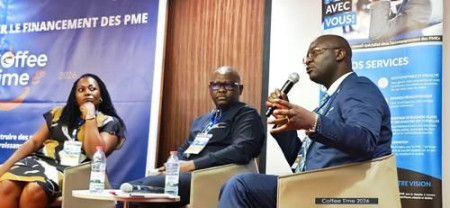
These options were discussed on March 25 in Douala at a national symposium titled “Coffee Time,” which focused on building stronger links between governments and local banks to support inclusive and sustainable growth. The event brought together more than 300 participants, according to organizers.
Tools to ease cash flow pressure
Among the solutions highlighted was factoring. This mechanism allows a company to sell its customer invoices to a specialized firm in exchange for immediate cash, rather than waiting for payment deadlines. Angela Ngo Ndouga, CEO of Yellow Factoring, said the approach can quickly ease liquidity constraints, helping businesses stabilize cash flow and speed up their operating cycles.
Leasing was also presented as a key financing tool. Under this model, a company uses equipment or property financed by a specialized institution, with the option to purchase it at the end of the contract. Yannick Kemayou, leasing manager at Société camerounaise d’équipements (SCE) in Douala, said leasing helps address a major barrier for many SMEs: the lack of collateral required by banks. It enables companies to finance assets such as vehicles, machinery, or business premises without tying up large amounts of cash upfront.
Islamic finance was also discussed as a credible alternative. Based on principles aligned with Sharia law, it prohibits interest, excessive speculation, and uncertainty, while promoting profit- and risk-sharing. It is tied to real economic activity and excludes investment in sectors considered non-compliant, such as alcohol and gambling.
Capital markets offer opportunities—but with conditions
Beyond these tools, speakers also pointed to the potential of the regional financial market. Following reforms by the Central African financial market regulator (Cosumaf), SMEs may, under certain conditions, raise funds through the stock market or brokerage firms.
Still, access remains limited. Marcel Ntonga, deputy CEO at Elite Capital Securities Central Africa (EXCA S.A.), said companies must meet several requirements, including operating as a joint-stock company with a board of directors, having at least CFA10 million in capital, and employing a minimum of five people.
For the experts gathered in Douala, these alternative tools offer real opportunities to reduce dependence on traditional bank financing. But they stressed that no solution will be fully effective without stronger coordination between public and private actors.
In an economy where SMEs play a central role, the challenge goes beyond access to funding. It also involves improving business structure, governance, transparency, and access to information. Steve Stéphane Bime, a banking and finance consultant and CEO of PME Advice, said companies must address these structural issues to build more sustainable financing models, secure their cash flow, and support long-term growth.
Frédéric Nonos

