

























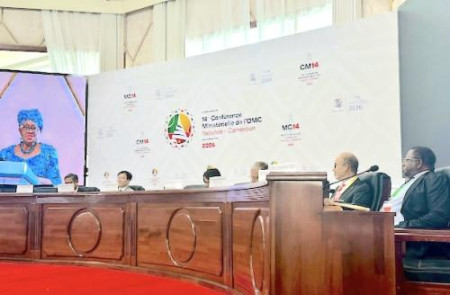
In Yaoundé, leading African cotton-producing countries are seeking to move the cotton agenda beyond trade. On the sidelines of the WTO’s 14th Ministerial Conference, the C-4+ group—Benin, Burkina Faso, Mali, Chad, and Côte d’Ivoire—unveiled a platform to attract investment into local processing, from fiber to textiles and apparel. The initiative was presented on March 25 during a high-level conference on the Partnership for Cotton.
The objective is clear: export less raw cotton and retain a larger share of value locally. Launched in 2024 with support from the WTO and other partners, the Partnership for Cotton aims to build, over the 2026–2030 period, a credible investment framework across the entire value chain.
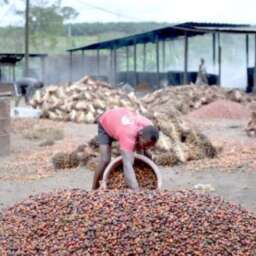
The stakes are significant. The C-4+ countries produce more than one million tons of cotton annually, accounting for about half of Africa’s output and nearly 4% of global production. Yet this production remains largely unprocessed. According to WTO Director-General Ngozi Okonjo-Iweala, 98% of cotton produced in the region is still exported in raw form. Promoters of the initiative estimate that $12 billion will be needed over ten years to develop spinning, textiles, and apparel, potentially creating hundreds of thousands of direct and indirect jobs.
This marks a strategic shift. For more than two decades, African producers have focused on challenging subsidies granted by major economies to their own cotton sectors, with limited results. The new approach prioritizes building domestic industrial capacity. As WTO Deputy Director-General Jean-Marie Paugam put it, the goal is to “move up the value chain.”
Cameroon seeks to position itself
For Cameroon, the Yaoundé meeting offers a dual opportunity. The country can strengthen its diplomatic role on a key issue for several African economies while positioning itself to benefit from the industrial and logistical spillovers of a more integrated cotton-textile value chain in Central Africa.
The issue carries clear economic weight domestically. As Trade Minister Luc Magloire Mbarga Atangana noted, cotton is one of the sectors identified to support regional industrialization. Data from Sodecoton illustrate its importance: the company reported revenue of CFA223.35 billion in 2024, net profit of CFA5.49 billion, and value added of CFA44.39 billion. In the same year, raw cotton exports generated CFA177.2 billion, representing 5.4% of the country’s total export earnings.
According to data cited by Investir au Cameroun from BEAC statistics, national production could reach around 350,100 tons in 2025, up from 340,000 tons in 2024. Beyond volume growth, however, local processing remains the core policy objective. Cameroon’s National Development Strategy 2020–2030 identifies the textile, garment, and leather industries as key drivers of structural transformation. It targets annual cotton production of 600,000 tons, industrial processing of at least 50% of local fiber by 2030, and the use of at least 60% domestically produced cotton in official uniforms.
A CFA180 billion industrial project, with a processing capacity of 12,000 tons per year, is part of this strategy. More broadly, authorities aim to increase the share of the secondary sector to 36.8% of GDP by 2030, with manufacturing value added expected to reach 25%.
From trade advocacy to industrial strategy
The significance of the Yaoundé initiative lies in this shift in perspective. African cotton is no longer framed solely as a trade issue tied to unequal competition. It is now positioned as an industrial lever capable of attracting investment, structuring regional value chains, and supporting productive transformation.
However, the ambition faces well-known challenges: substantial financing needs, high energy costs, logistical constraints, industrial competitiveness, and the ability to coordinate the entire value chain from spinning to garment production. The credibility of this new approach will depend less on trade negotiations than on progress in addressing these structural constraints.
For Cameroon and its regional partners, the challenge is no longer just to export more cotton. It is to process it locally, capture a greater share of value, and transform cotton into a driver of industrial development rather than a raw commodity for external markets.
Baudouin Enama

