

























- WTO members meet in Yaoundé amid rising geopolitical and trade tensions
- Reform efforts face deadlock over consensus rules and major power rivalries
- Talks carry high stakes for Africa on investment, trade rules, and market access
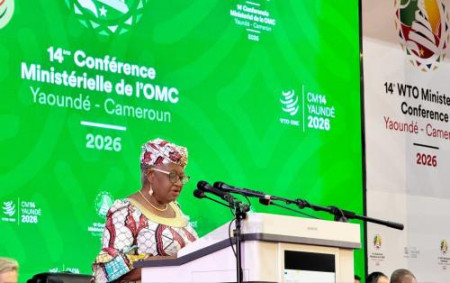
The World Trade Organization’s 14th Ministerial Conference opened in Yaoundé on March 26 against a backdrop of mounting strain in global trade, as member states attempt to revive an institution weakened by stalled negotiations and deepening geopolitical divides.
Over four days, delegates are meeting in Cameroon’s capital to address growing protectionism, persistent deadlock within the organization, and disruptions linked to the war in the Middle East, which continue to weigh on global trade flows and supply chains.
At the opening session, WTO Director-General Ngozi Okonjo-Iweala warned of the most severe disruptions to the global trading system in nearly 80 years. She pointed to broader shifts in the international order, marked by rising skepticism toward multilateral cooperation.
Reforming a stalled institution
For Cameroon, hosting the conference carries diplomatic, economic, and symbolic weight. It is only the second WTO ministerial meeting held in Africa, after Nairobi in 2015, placing Yaoundé at the center of debates over the future of global trade.
Many delegations see this gathering as a decisive moment for the WTO, whose ability to deliver agreements has been constrained by its consensus-based decision-making process. Calls for reform focus on updating governance rules, restoring the dispute settlement system—which has been paralyzed since 2019—and addressing concerns from developing countries.
Cameroon’s Minister of Trade, Luc Magloire Mbarga Atangana, urged members to equip the organization with tools better suited to current challenges and to rebuild trust in the multilateral trading system.
The talks are also unfolding amid a more assertive U.S. trade stance. During Donald Trump’s second term, Washington has stepped up its use of tariffs and bilateral agreements, challenging key principles of multilateralism and widening divisions among major economies, reducing the chances of a strong consensus in Yaoundé.
High-stakes debates for African economies
Among the most contentious issues is the future of the “most favored nation” principle, a cornerstone of the WTO system that ensures equal treatment among trading partners. While the United States is pushing to revise its scope, China and several developing countries are defending it as essential to the organization’s framework.
Ministers are also considering whether to extend the moratorium on customs duties for electronic transmissions and whether to incorporate the plurilateral agreement on investment facilitation—already backed by around 130 countries—into WTO rules.
For Cameroon, the outcome of these discussions is directly tied to its economic priorities, including improving competitiveness, attracting investment, and diversifying its economy. Progress on investment facilitation, trade predictability, and stable international rules could help strengthen the country’s business environment.
By hosting the conference, Cameroon is seeking to raise its diplomatic profile while positioning itself within negotiations that could shape the future of global trade in the years ahead.
Baudouin Enama

