







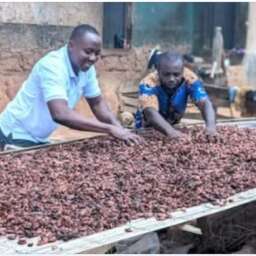










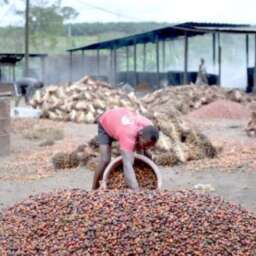









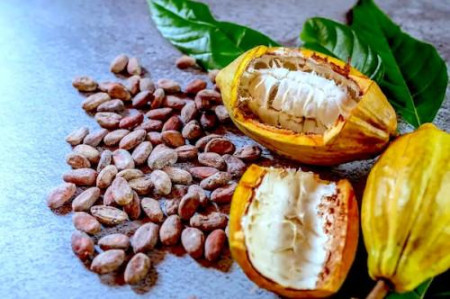
Cocoa bean prices in Cameroon stood between CFA1,200 and CFA1,300 per kilogram as of March 24, 2026, according to data from the sector information system (SIF) managed by the National Cocoa and Coffee Board (ONCC). At this level, cocoa has returned to price parity with robusta coffee, a situation not seen since March 3.
On that date, robusta prices had exceeded cocoa for the first time in many years on the local market. Earlier, on February 18, both commodities had already reached the same price level, marking a rare convergence.
Since then, the gap had widened in favor of robusta, breaking with the usual pricing hierarchy. Historically, cocoa has consistently traded above robusta, the most widely grown coffee variety in Cameroon.
A trend that underscores cocoa’s weakness
The recent shift between cocoa and coffee prices reflects the downturn affecting cocoa since the start of the 2025–2026 season. After peaking at CFA6,000 per kg during the 2023–2024 season and reaching a high of CFA5,400 the following campaign, cocoa prices have dropped sharply.
They are now trading between CFA1,200 and CFA1,300 per kg, up from CFA1,050–1,150 a month earlier, according to SIF data.
Despite this recent uptick, prices remain well below government expectations. At the start of the season, authorities had projected a range of CFA3,200 to CFA5,400 per kg.
Analysts attribute the gap between actual prices and official forecasts to a less favorable global market environment than initially anticipated.
Global supply pressures persist
Global cocoa production is expected to return to surplus in the 2025–2026 season, extending the recovery that began in 2024–2025 after three consecutive deficit years.
According to market analysts, this expected surplus will continue to weigh on prices throughout the season, both on international markets and in producing countries such as Cameroon.
In this context, cocoa’s return to parity with Robusta reflects not a strong recovery, but continued weakness in the sector.
BRM

