











Cameroon’s government has signed two memorandums of understanding with Thermosun Cameroon and Blue Energy Holding for projects that could mobilize CFA856.8 billion (about $1.4 billion) to develop waste treatment and energy recovery facilities in Douala and Yaoundé.
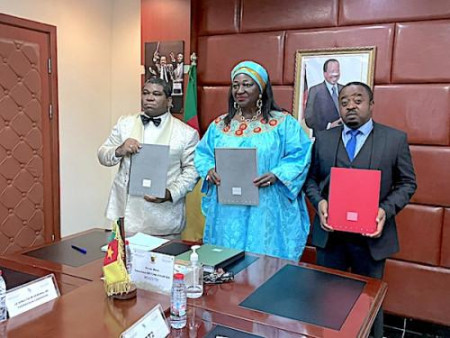
The agreements were signed on March 12 in Yaoundé by Minister of Housing and Urban Development Célestine Ketcha Courtès. The initiatives aim to build industrial units capable of converting urban waste into energy and other resources.
The deals follow the national forum on urban waste management held on May 6–7, 2025 in Yaoundé, where authorities described sanitation conditions in major cities—especially Douala and Yaoundé—as “concerning.” Among the solutions discussed at the time was the creation of a dedicated account to secure payments for waste management operators.
For now, however, the agreements remain expressions of intent. The gap between the signing of memorandums and the actual implementation of large industrial investments can be substantial.
Waste Collection Already Under Pressure
The new projects are being proposed in a sector already under strain.
In Douala, daily waste production is estimated at 2,700 tons. For 2026, the city allocated CFA7 billion for waste management and awarded a CFA954 million contract to Genelcam to handle part of the collection.
In Yaoundé, the situation is similar. In November 2024, Hysacam secured three of the four contracts in a municipal tender worth more than CFA45 billion. The fourth contract received no bids, reflecting persistent difficulties in organizing the waste collection market in the capital.
In both cities, the challenge remains the same: rising waste volumes, saturated infrastructure and insufficient resources to stabilize the service.
Thermosun Plans CFA276.8 Billion Waste Recovery Units
The first project is led by Thermosun Cameroon, which plans to build two waste recovery plants in Douala and Yaoundé with an investment estimated at CFA276.8 billion.
The facilities aim to convert urban waste into biogas, electricity, hydrogen and compost using technology developed by Smargine Engineering.
According to the company, the plants would collect about 1,500 tons of waste per day and process 833 tons, equivalent to nearly 280,000 tons per year.
At this stage, however, neither the project timeline nor the financial structure has been made public.
Blue Energy Proposes Larger CFA580 Billion Program
The second project, led by Blue Energy Holding, outlines a broader plan with a total investment estimated at CFA580 billion.
The group also proposes building two waste treatment plants in Douala and Yaoundé. According to the promoters, 30% of the funding—around CFA174 billion—would come from the Cameroonian state, although the details of this contribution have not been specified.
Blue Energy says the facilities could process up to 3,000 tons of waste per day and generate around 912 GWh of electricity annually. The power would be supplied to urban grids and potentially support future Bus Rapid Transit (BRT) systems planned for both cities.
The proposal also includes the deployment of 600 eco-friendly buses, a fleet of 1,000 biogas-powered trucks—including 400 assigned to Douala and Yaoundé—and the installation of 10,000 waste bins to encourage sorting at the source. The developers also project the creation of more than 15,000 direct and indirect jobs.
As the scope of the project expands, however, questions about its practical implementation become more pressing.
Projects Far Larger Than Current Sector Resources
The scale of the proposed investments contrasts sharply with the resources currently available in the waste management sector.
Customs data cited by Investir au Cameroun show that the waste collection tax generated CFA60.6 billion between 2020 and 2022, or roughly CFA20.2 billion per year nationwide. That represents about CFA10.1 billion annually for each of the urban communities of Douala and Yaoundé.
In Yaoundé alone, an earlier World Bank study cited by Hysacam estimated that at least CFA15 billion per year would be required to properly manage waste collection. Current funding therefore remains below the level considered necessary to stabilize the service.
This gap helps explain the recurring operational difficulties observed in both cities.
Logistics Remain the Immediate Challenge
In January 2026, Hysacam called on Ceneema to help relieve pressure on the PK10 landfill in Douala and the Nkolfoulou landfill in Yaoundé, both of which are nearing capacity.
In Douala, the operator is also expanding a network of waste transfer centers designed to reduce the logistics costs of collection.
The issue remains structural: before energy recovery, the primary challenge is still collecting, transporting and managing the growing volumes of waste.
The projects proposed by Thermosun and Blue Energy aim to reshape that equation by turning waste into energy, fuel and economic resources.
The Real Test: From Memorandum to Industrial Plants
For these projects to succeed, several conditions will have to be met: secure financing, sustainable public participation, proven technology and coordination with existing operators.
Between an investment announcement and the commissioning of industrial plants, delays, negotiations and technical obstacles can be significant.
For now, the CFA856.8 billion announced represents less a completed transformation than a bet on the ability of public and private actors to build an industrial waste sector in Cameroon. The stakes go beyond waste collection itself and point to a broader question: whether the country can turn a persistent urban challenge into a sustainable economic activity.
Frédéric Nonos

