





















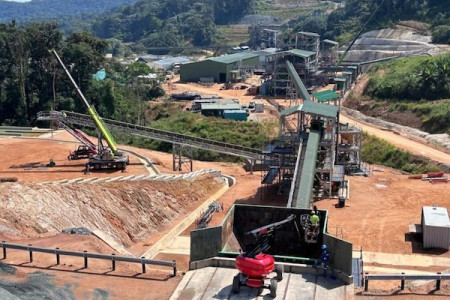
Construction of the future Yicheng pharmaceutical complex has entered a decisive stage in Meyo, along the Yaoundé–Nsimalen highway. On March 3, 2026, the project’s promoter and CEO of Yicheng Pharmaceutical Group Fabrication Co. Ltd., Idriss Confiance Mbe, welcomed a delegation of more than 30 Chinese engineers tasked with supporting the final work on the first phase of the industrial project, whose total investment is estimated at CFA530 billion.
Their mission focuses on supervising finishing works, installing and calibrating several industrial machines, and preparing the gradual commissioning of some technical facilities. During a working meeting, the Cameroonian executive set a clear target for the team: complete their mission within three months. He stressed that this phase is critical to delivering a project he describes as central to the future of Cameroon’s pharmaceutical industry.
First phase nearly 60% complete
Project officials say the first phase—valued at CFA30 billion—is now close to 60% complete. The complex aims to manufacture a wide range of medicines locally, with the goal of strengthening pharmaceutical self-sufficiency in Cameroon and, more broadly, across Central Africa.
Once operational, the plant is expected to help reduce dependence on imports and limit the circulation of counterfeit medicines in the regional market. The project therefore goes beyond a simple industrial investment. It also addresses public health security and the development of a local supply base in a sector still largely dominated by foreign products.
The initiative comes at a time when domestic pharmaceutical manufacturing plays only a minor role in supplying Cameroon’s market. According to the Competitiveness Committee, a think tank linked to the Ministry of Economy, the country’s pharmaceutical industrial base remains largely underutilized.
Despite the presence of around 15 production units, local manufacturers account for only about 5% of the national market for medicines and medical supplies, while imports continue to cover roughly 95% of demand.
This reliance on foreign supply has grown in recent years. Cameroon’s pharmaceutical imports rose from CFA69.5 billion in 2010 to about CFA170 billion in 2024, increasing pressure on the country’s foreign currency reserves.
Structural constraints slowing the sector
The slow development of local production is linked to several structural challenges. Industry operators cite high production costs, sometimes outdated or insufficient equipment, competition from informal and illicit drug markets, and a tax burden they describe as “suffocating.”
Against this backdrop, the Yicheng project stands as a large-scale industrial test. Its success will depend on completing construction within the announced timeline, installing critical equipment, and turning the CFA530 billion investment into real manufacturing capacity.
Amina Malloum

