
















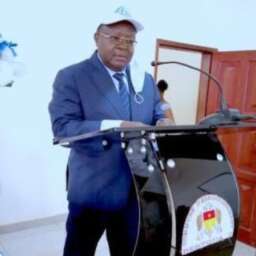






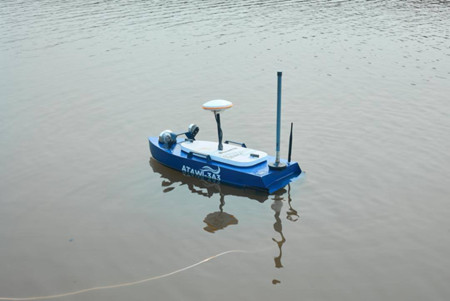
Cameroon has unveiled a locally engineered autonomous marine drone designed to monitor water quality, detect pollution and support port security operations, marking a new step in the country’s drive to develop high-tech industrial solutions. The device, named ATAWI-3A3, was officially presented on 27 February 2026 in Douala by Jacques Eonè, promoter of Sparte Robotics, during the COCKTECH event. Developed entirely by young Cameroonian engineers, the modular drone is aimed at port authorities, maritime operators and environmental managers seeking real-time data solutions.
According to Sparte Robotics, the ATAWI-3A3 is a Uncrewed Surface Vessel built to carry out water sampling, environmental monitoring, bathymetric surveys and security inspections in port and coastal zones. It can navigate at speeds of up to 15 km/h and operate autonomously for between one and two hours. Equipped with water quality sensors, sonar systems to measure depth and instruments capable of analysing parameters such as turbidity, temperature and conductivity, the drone collects real-time data through an onboard computer. Its embedded software integrates artificial intelligence components to assist predictive analysis and mission optimisation. The system coordinates sensors, processing units and actuators to ensure stability, navigation and task execution without human presence onboard.
During the launch ceremony, the project promoter revealed that it was developed in collaboration with the Port Authority of Kribi (PAK), following exchanges held during the ELVIATECH Robotics Competition and the National Olympiads of Robotics and Artificial Intelligence. Habib Iya, Head of the PAK Representation in Douala, said the solution responds to operational challenges faced by ports.
“When we receive vessels, we are sometimes confronted with cases of discharge. We must ensure that the ecosystem is preserved. In this context, such a tool could verify water quality,” he stated.
On his part, Jacques Eonè added that the drone was conceived to address ballast water management and fraudulent discharges.
“We concluded that environmental issues in port areas required local, modular solutions, and developed a tool capable of detecting fraudulent discharges,” he explained.
Beyond pollution control, the ATAWI-3A3 is designed to support coastal mapping and infrastructure inspections, including bridge assessments such as those conducted at Edéa. Its bathymetric data management capacity enables detailed study of Cameroon’s coastline, contributing to maritime planning and safety. According to Sparte Robotics, a strategic collaboration with PAKAZURE is being explored to reinforce the project’s artificial intelligence and data-processing capabilities.
Mercy Fosoh

