




























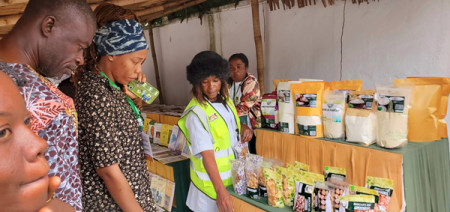
The Services for Support to Local Development Initiatives (SAILD) has launched a renewed push for the incorporation of local flours into bread production as part of Cameroon’s import substitution policy. The organisation unveiled technical and material support for artisan bakeries during the Local Flour Days, held on 26-27 February in Yaounde.
The event, organised at the headquarters of the Citizens Association for the Defence of Collective Interest (ACDIC) with financial backing from the Agroecology Fund, brought together flour producers, bakers, consumers, distributors and civil society actors to promote alternatives to imported wheat and reduce pressure on the country’s import bill.
Organisers said the initiative seeks to strengthen local artisan bakeries that incorporate local flours into bread and pastry production, while encouraging sustainable consumption.
According to SAILD, bread remains one of the most widely consumed foods in Cameroon, with production largely dependent on imported wheat flour. Data from the National Institute of Statistics (INS) presented at the event, wheat imports reached 887,434 tonnes in 2023 at a cost of CFA 178.3 billion. The trend continued in 2024, with total cereal imports estimated at CFA 543.7 billion, including CFA 214 billion spent on wheat alone. SAILD stated that the gradual integration of local flours into bread production is intended to reduce this dependence and support national agricultural value chains.
A bread baking contest formed part of the two-day programme, with Gabrielle Mathan emerging winner among 10 participants. Mathan, who has been baking since 2019, produced bread made from potato flour and sesame seeds, selected as the top entry by a jury comprising a nutritionist, a flour production expert and a baker with more than 30 years’ experience. Participants were assessed on flour quality, hygiene, post-production bread quality and innovation. Mathan received a CFA 300,000 cash prize, a trophy and technical support from SAILD and ACDIC.
Kouang Rodrigue, representative of SAILD, described the competition as “a pretext for promoting the incorporation of local flour in bread production”. He said: “We are all aware of the difficulties in obtaining wheat in recent years due to global conflicts. We are seizing the opportunity of import substitution promoted by the government. This is a practical case of substituting wheat with local flour.” He added that organisers hoped bakery promoters would recognise the importance of integrating local flour into production.
Cameroon’s import substitution policy seeks to reduce reliance on external markets and strengthen domestic production. Promoters of Local Flour Days say expanding the use of locally sourced flours in bread production represents a targeted intervention within the broader strategy to curb food imports and reinforce national agricultural sectors.
Mercy Fosoh

