

























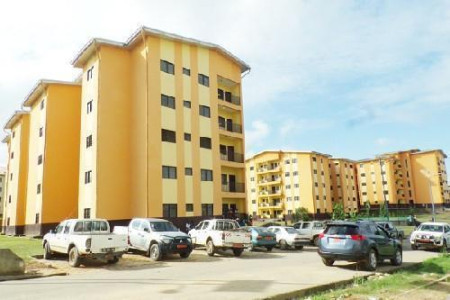
Launched in 2009, Cameroon’s program to build 10,000 social housing units, alongside the development of 50,000 serviced plots, has delivered 1,130 units out of 1,675 planned under its pilot phase.
Additional housing completed under the three-year Emergency Plan for Growth Acceleration (Planut), the Chinese-backed program and small and medium enterprise housing initiatives bring the total number of completed units to 3,585.
The figures were disclosed on February 12, 2026, in Douala by the Minister of Housing and Urban Development, Célestine Ketcha Courtès, during a key handover ceremony for 57 new homeowners in Mbanga Bakoko. According to the minister, 670 units have already been delivered in Douala, with 40 more expected by March and 30 in April.
Gradual Progress, Lingering Gaps
Since the first handovers in 2013, nearly 3,000 families have been housed in Douala, Yaoundé, Bafoussam, Limbé, Bamenda and Sangmélima, the minister said. The Mbanga Bakoko ceremony was presented as part of a gradual rollout, though overall progress remains well below initial objectives.
When she took office in 2018, only 420 units had been completed, highlighting early implementation challenges. The minister attributed delays to dysfunctions, including the limited financial and logistical capacity of some local small and medium enterprises, which led to work stoppages.
To revive the program, the government contracted new companies described as having proven performance, using exceptional agreements through the Ministry of Public Procurement. Authorities say this contractual shift was intended to address weaknesses in project execution.
Despite these adjustments, results remain modest compared with demand. Official estimates place Cameroon’s social housing deficit at around 2.5 million units, a situation authorities have described as acute.
Land and Tax Pressures Add New Constraints
To reduce the deficit, the government says it has opened discussions with several private partners — Pnhg, Addoha, Lafak and Wagas — to finalize conditions for launching new construction phases. However, access to land remains a structural bottleneck.
According to the housing ministry, discussions with the Ministry of State Property, Surveys and Land Tenure have advanced on land titles, with priority given to issuing them in 2026. A new fiscal measure could further complicate project economics.
Since January 2026, the government has ended the value-added tax exemption on social housing, introducing a 10% VAT on social housing operations, including interest, sales and rentals. The measure is expected to increase project costs and could affect affordability and access to social housing.
Frédéric Nonos

