





























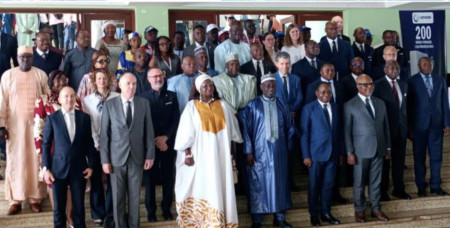
The Government has signed financing conventions and works contracts to reconfigure Yaoundé’s drinking water network. The agreements activate a 36‑month infrastructure programme designed to expand supply capacity, improve network performance and raise revenues for the national water utility corporation, CAMWATER. The agreements were formalised on Friday, 13 February 2026, during a ceremony chaired by the Minister of the Economy, Planning and Regional Development, Alamine Ousmane Mey, in the presence of Gaston Eloundou Essomba and the Director General of CAMWATER, Dr Blaise Moussa.
The programme targets households and economic operators in Yaoundé and neighbouring localities, including Soa, Akak, Mfou, Bikok and Mbankomo, particularly those without reliable access to potable water. It aims to address service interruptions and extend potable water access to areas not yet connected to the network. Industries, schools and hospitals are also included in the rollout.
Authorities state that under the plan, network absorption capacity will increase from 300,000 cubic metres per day to 480,000 cubic metres per day, drawing supply from the Batchenga (PAEPYS), Akomnyada, and Mefou treatment plants. The programme seeks to eliminate rationing and guarantee a minimum pressure of 1.5 bar across the system. Thirty thousand new household connections are scheduled, while network efficiency is set to rise from 52 per cent to 75 per cent. CAMWATER projects a 60 per cent increase in turnover in the Yaounde zone as consumption levels grow.
Financing for the first two lots, amounting to CFA 111.6 billion, has been secured from ING Bank Belgium and Belfius Bank. Deutsche Bank Italy will finance a third lot valued at CFA 25.2 billion and is due for signature.
The contracts were awarded to three international operators: the Putman/Phonix Environnement consortium and ASPAC Technics, both based in Belgium, and Gruppo Aturia of Italy. Each will operate in distinct geographical zones to accelerate delivery.
The Putman/Phonix Environnement consortium will create three peripheral distribution zones in Abomé, Zibi Antenne, and Minkoameyos, including pumping stations with a capacity of up to 1,450 cubic metres per hour and reservoirs with a total storage capacity of 13,250 cubic metres. Eighty-five kilometres of primary and secondary pipelines will be laid in critical districts, and ageing grey cast-iron and steel pipes will be replaced to reduce water losses. ASPAC Technics will install 62 kilometres of additional pipelines and reinforce transfer lines, including the 11.5-kilometre Etoudi-Nkoayos axis and the 1.5-kilometre Grande Mosquée-Messa link. Italy’s Gruppo Aturia will deploy 300 kilometres of tertiary polyethene piping and supply 30,000 complete connection kits.
A total of 455 kilometres of new pipelines will be laid, including 300 kilometres of tertiary network in high-density areas. Ageing grey cast iron and steel pipes will be replaced to reduce physical water losses.
The project forms part of Cameroon’s National Development Strategy, NDS30 and follows authorisation granted by the President of the Republic in April 2025 to the Ministry of the Economy to conclude financing arrangements. With contracts now signed and financing in place, works are scheduled to commence imminently.
Mercy Fosoh

