





















G-Stones Resources, developer of the Grand-Zambi iron ore project in Cameroon’s South region, is set to receive CFA41.2 billion in financing from five local banks: Afriland First Bank, CBC, CCA Bank, BGFI Bank and UBA.
Under the announced terms, the funds will be refinanced through the special facility of the Bank of Central African States (BEAC), known as “window B,” dedicated to financing productive sector projects in the CEMAC zone (Cameroon, Congo, Gabon, Equatorial Guinea, Chad and the Central African Republic).
The activation of “window B” was approved at BEAC’s Monetary Policy Committee meeting held on December 15, 2025 in Yaoundé.
However, the central bank has set conditions for access to the facility. “The mobilization of this financing will be subject to the fulfillment of the following conditions: the prior or simultaneous completion of self-financing, to be increased from CFA26,723 million to CFA27,500 million; and the borrower’s written commitment to allocate the funds exclusively to the construction and operation of an iron mine in Grand-Zambi,” the committee said.
Afriland leads, BGFI second contributor
As lead bank of the consortium, Afriland First Bank will provide CFA16.5 billion. BGFI Bank Cameroon is expected to follow with CFA8.1 billion.
UBA and CBC are set to contribute CFA6.6 billion and CFA5.7 billion, respectively, while CCA Bank would provide CFA4.1 billion.
The CFA41.2 billion envelope represents 60% of the total financing estimated at CFA68.7 billion, excluding working capital needs assessed at CFA7.9 billion.
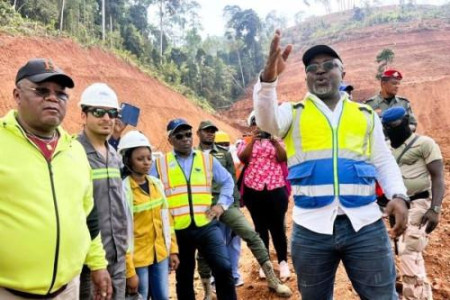
Controlled by Cameroonian billionaire Dieudonné Bougne, G-Stones Resources S.A. holds a 14-year mining permit for the Grand-Zambi deposit.
Official reserves are estimated at 150 million tons, with an average grade of 29.45%. The financing is expected to support annual production of 1.3 million tons of iron ore concentrate for export.
The company says it already has 600,000 tons of raw ore stockpiled on site for processing, under an open-pit mining operation.
Kribi exports expected despite no dedicated mineral terminal
Exports of enriched cargoes have been expected since 2025 through the deep-sea port of Kribi, which does not yet have a dedicated mineral terminal.
Port officials say existing terminal facilities can handle the initial shipments.
“We recently commissioned the second container terminal at our port, which has tripled capacity in seven years. We are therefore ready to handle G-Stones’ first exports,” said Patrice Loumou.
The head of planning and industrial development at the Port Authority of Kribi was speaking on May 15, 2025 in Douala during a debate on “Cameroon’s mining sector: economic challenges, local transformation and benefits for communities.”
Brice R. Mbodiam

