















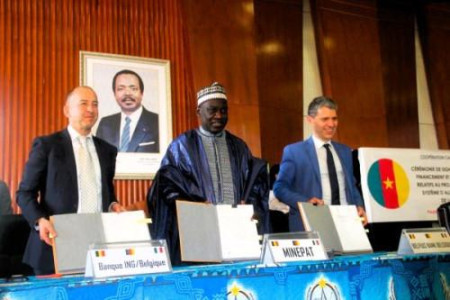
Cameroon’s Economy Minister Alamine Ousmane Mey on Feb. 13, 2026 signed financing agreements worth 111.6 billion CFA francs with three foreign banks: Belgium’s ING Bank (39.36 billion CFA francs), Belgium’s Belfius Bank (39.36 billion CFA francs) and Deutsche Bank Italy (25.27 billion CFA francs). The financing will support three components of the Yaoundé Drinking Water Supply System Reconfiguration Project.
The project extends the Yaoundé Drinking Water Supply Project from the Sanaga River (Paepys), completed and inaugurated in 2024. Paepys included the construction of a new water treatment plant at Batschenga, in the Centre region, with an initial capacity of 300,000 cubic metres per day, expandable to 400,000 cubic metres.
The Ministry of Water and Energy says that despite the increase in production, existing infrastructure is insufficient to ensure supply across the capital. The Akomnyada plant currently produces 100,000 cubic metres per day, against estimated demand of 315,000 cubic metres. Paepys is expected to cover the 215,000-cubic-metre shortfall. However, authorities say the current distribution network configuration prevents some neighbourhoods from being supplied, making a system overhaul necessary to accommodate the new source and higher volumes.
Objectives: integrating 285,000 cubic metres per day and 30,000 new connections
When presenting her 2026 budget to the National Assembly in December 2025, the Minister of Water and Energy said the project aims to integrate an additional 285,000 cubic metres per day from Paepys into Yaoundé’s water network. It also seeks to raise access to piped drinking water in Greater Yaoundé, including Soa and Mbankomo, from 40% to 61% through 30,000 new household connections.
Efficiency, storage and network expansion
Beyond expanding coverage, Water Minister Gaston Eloundou Essomba said the project will improve network efficiency from 50% to 71%, increase storage capacity from 100,310 cubic metres to 122,810 cubic metres, and extend the main, secondary and tertiary networks with 525 kilometres of new pipelines.
Mey said the project would strengthen access to basic services and support Cameroon’s efforts to meet Sustainable Development Goal 6, SDG 6, which aims to ensure universal access to water and sanitation and the sustainable management of water resources.
The agreements were signed as Yaoundé hosted the 23rd congress of the African Water and Sanitation Association, AAEA. Participants at the conference said meeting SDG 6 by 2030 would be difficult given persistent gaps in access to drinking water and sanitation across the continent. In Cameroon, officials say more than 30% of the population still lacks access to safe drinking water, four years before the United Nations deadline.
Brice R. Mbodiam

