






















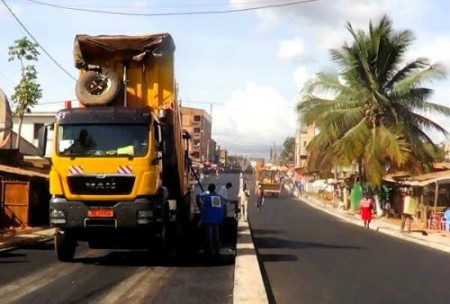
Cameroon’s Road Fund is operating at roughly half of its planned annual budget, constrained by recurring cash shortages. The fund, which finances road maintenance nationwide, has not received the full allocations set out in successive finance laws.
According to the Ministry of Public Works, its technical supervisor, actual collections reached CFA35 billion in 2023, CFA30 billion in 2024 and CFA35 billion in 2025 — well below the CFA60 billion allocated each year.
The ministry argues that the shortfall breaches the agreement establishing the automatic debit mechanism, designed to guarantee the Road Fund monthly transfers equal to one-twelfth of its annual budget to ensure uninterrupted financing of maintenance works.
In practice, liquidity pressures have disrupted the mechanism. In November 2025, transfers to the Road Fund were suspended, reflecting broader fiscal trade-offs.
Salaries, pensions and external debt prioritized
In a letter dated Nov. 11, 2025, Finance Minister Louis Paul Motaze informed the fund’s administrator that automatic debits would be halted for November and December. The stated objective was to allow the Treasury to meet priority obligations, including salary and pension payments and part of the external debt service.
At the time, arrears on external debt stood at CFA145 billion. The decision to divert funds from road maintenance underscores the government’s fiscal hierarchy amid mounting pressures.
For the 2025 fiscal year, the Road Fund reported a projected budget of CFA61.4 billion. Of that amount, CFA25.8 billion was injected into the domestic economy through payments to contractors.
The persistent gap between the CFA60 billion annual allocation and actual receipts of CFA30 to CFA35 billion is weighing on maintenance planning and the regular execution of works.
Ludovic Amara

