






























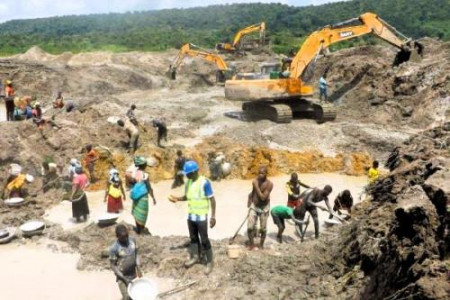
Cameroon is tightening its gold traceability strategy, with the government set to revoke artisanal semi-mechanized mining permits held by operators that fail to meet administrative and environmental requirements.
In a statement issued on February 9, the Ministry of Mines, Industry, and Technological Development said the permits will be withdrawn from February 20, 2026, in line with provisions of the December 2023 Mining Code.
The decision follows a meeting held on January 21, 2026, between the ministry, the National Mining Corporation (Sonamines), and sector operators. Miners were given 15 days to pay site rehabilitation guarantees and sign binding specifications with relevant stakeholders. The administration now considers this deadline to have been “largely exceeded.”
As a result, the affected sites will be closed and their permits withdrawn under Article 168(2) of the Mining Code.
Beyond an administrative enforcement measure, the government is seeking to regain control of a sector long dominated by informal activity. Operators that remain compliant will be required, within three months, to install a closed-loop mining system or partner with an entity that already operates one. They must also submit a preliminary feasibility study specifying average ore grades and a minimum production threshold.
The aim is to allow the state to better align actual production with operator declarations and, in turn, estimate expected tax revenues.
Ban on night work
The ministry is also introducing stricter upstream controls. Any new application for artisanal mining will now require prior authorization to access the site, issued by the regional mining delegate, to carry out technical sampling. The ministry also reiterated the ban on night work and on artisanal mining activities within exploration permits.
These measures reflect broader concerns over large-scale gold leakage from official channels. For decades, locally produced gold contributed little to public finances. From independence through the 2000s, national reserves totaled just 37 kg. More recently, about 1.5 tons have been channeled to the Treasury, an improvement but still seen as marginal compared with estimated potential.
The government now aims to capture more revenue from gold, notably the 25 % synthetic tax and the 5 % export tax, both calculated on actual production. Talks are under way with private partners to organize gold collection directly at mining sites.
The reform also addresses security concerns. Semi-mechanized artisanal mining is viewed as a driver of smuggling, environmental degradation, and, in some cases, local tensions over control of deposits.
Underlying the policy shift is a persistent gap between national and international data. The 2023 EITI report shows that, according to customs data, only 22.3 kg of gold were officially exported in 2023. This contrasts sharply with statistics from the United Arab Emirates, the main destination for Cameroonian gold, which report imports of 15.2 tons from Cameroon over the same period. More than 90 % of that volume is said to have been shipped to the UAE.
Amina Malloum

