
































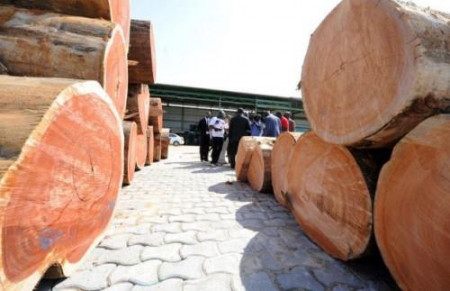
Between 2019 and 2023, the share of logs—unprocessed wood—in Cameroon’s total exports was cut in half, falling from 8% to 4%. The shift is highlighted in the midterm evaluation report on the implementation of the National Development Strategy 2020–2030, published by the Ministry of the Economy.
According to the report, the decline in log exports was offset by stronger growth in processed wood exports, particularly sawn timber. “Cocoa beans account for a quarter of non-hydrocarbon exports. This product is followed by sawn wood, which represents between 14% and 16% of non-hydrocarbon exports. It is worth noting with satisfaction that processed wood generates more revenue than logs, whose share continues to decline, from 8% in 2019 to 4% in 2023,” the report said.
The trend reflects the government’s strategic direction to increase local wood processing and gradually reduce log exports, ahead of a planned ban on raw timber exports across the CEMAC region—Cameroon, Congo, Gabon, Equatorial Guinea, Chad, and the Central African Republic—by 2028 at the latest.
Shift toward local processing
To prepare forest operators for this deadline and steer them toward secondary and tertiary processing, the Cameroonian state has gradually tightened export taxes on logs and on first-stage processed timber. Between 2017 and 2024, the export duty on logs rose from 17.5% to 75% of the FOB value of the species exported.
Measured in relative terms, these successive increases set out in annual finance laws represent an overall rise of around 350% in the taxation of log exports. Tax pressure on first-stage sawn timber increased more moderately, up 165% between 2016 and 2023, according to estimates from the Cameroon Wood Industry Group.
At the same time, incentive measures have been introduced to support local value creation. Since 2023, the finance law has provided tax exemptions for equipment used in wood processing, a measure renewed in subsequent budget cycles. In addition, the government has announced the allocation of two industrial zones dedicated to wood processing in the forest and mining region of the East, covering a combined area of 224 hectares.
The impact of this policy mix still needs to be consolidated. An early positive signal emerged in 2022, when the National Institute of Statistics reported a rise in veneer exports, a product reflecting a higher level of processing than simple sawing. That year, Cameroon exported 57,850 cubic meters of veneers, up 15% year on year.
Brice R. Mbodiam

