























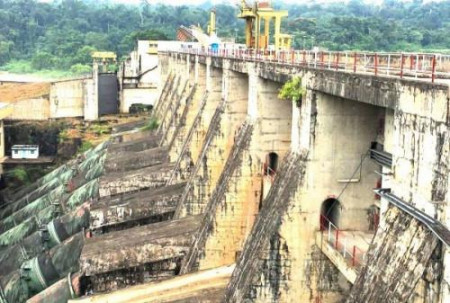
Cameroon’s power system has sufficient installed capacity on paper to meet demand. Speaking to business leaders in Douala on January 22, Minister of Water and Energy Gaston Eloundou Essomba said available generation capacity on the Southern Interconnected Grid (RIS) stands at 1,536 MW. Of this total, 1,365 MW comes from hydropower and gas-fired plants, while 171 MW is generated from fuel-based thermal units. Estimated demand is 1,206 MW. Under optimal conditions, supply would therefore exceed demand without the need for heavy reliance on thermal generation.
Despite this apparent surplus, power outages continue to affect several localities. The reason lies in a combination of structural constraints impacting generation, transmission, and distribution at the same time. Low rainfall recorded in recent years has reduced reservoir levels, creating an estimated water deficit of 3 billion cubic meters. This situation requires strict management of available reserves and mechanically limits hydropower generation.
The gap between installed capacity and actual output illustrates the extent of the constraint. At Nachtigal, inflows of around 650 cubic meters per second translate into 260 MW of output, well below the expected 420 MW. At Songloulou, 900 cubic meters per second result in 320 MW, compared with a projected 384 MW. At Memve’ele, production drops to 100 MW with inflows of 250 cubic meters per second, far short of the planned 211 MW. These hydrological limits are compounded by unit shutdowns linked to maintenance shortfalls, notably at plants such as Kribi Power Development Company (KPDC), further reducing overall energy availability.
Transmission represents a second major bottleneck. On the Edea–Douala corridor, maximum transfer capacity is capped at 540 MW, while demand reaches 671 MW, despite an available supply of 811 MW. This mismatch prevents electricity from being effectively delivered to the country’s main consumption centers. Several strategic substations, including Bekoko, Makepe, Deido, and Koumassi, are regularly exposed to overloads.
On the distribution side, vulnerabilities continue to accumulate. These include the collapse of wooden poles, overloading of medium- and low-voltage transformers, and saturation of certain lines. Such incidents cause losses and localized imbalances, particularly in major urban areas. To maintain service continuity, the system operator increasingly relies on fuel-fired thermal plants, despite their high cost. Monthly spending on these compensatory operations is estimated at CFA5.5 billion, adding pressure to a sector already weakened by cash-flow constraints and payment arrears.
In response to these challenges, the government says it has launched structural reforms through the National Energy Compact, developed under the Mission 300 initiative. The stated objective is to improve generation, strengthen the grid, and secure power supply in support of economic development.
Amina Malloum

