


























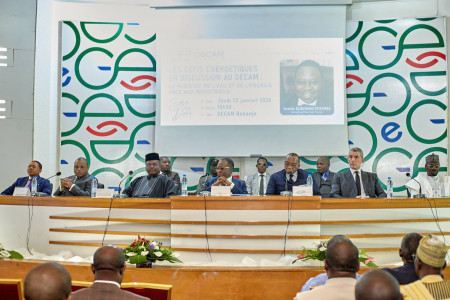
Cameroon’s electricity supply deficit moved to the centre of economic debate on 22 January in Douala, where government officials and business leaders met to address persistent power shortages affecting industrial activity. The technical session brought together the Ministry of Water and Energy (MINEE) and members of the GECAM group of enterprises, with discussions focused on the financial imbalance in the power sector and its impact on productivity, investment, and competitiveness. Participants agreed that the gap between electricity demand and available supply remains a structural constraint for businesses, particularly in industrial hubs such as Douala, where outages and power quality issues disrupt operations.
According to GECAM president Célestin Tawamba, the electricity deficit is identified by 80 per cent of member companies as their primary operational challenge. He cited frequent load-shedding and unstable power quality, noting what he described as a paradox between the expansion of generation infrastructure and the limited availability of electricity for end users.
In response, the Minister of Water and Energy, Gaston Eloundou Essomba, stated that the core issue lies in the sector’s financial imbalance. He disclosed that ENEO Cameroon records average monthly revenues of FCFA 31 billion, against operating charges estimated at FCFA 44 billion, resulting in a monthly shortfall of FCFA 13 billion. The company’s accumulated debt stands at FCFA 177 billion. To address this, the government plans to refinance ENEO’s liabilities through a local banking syndicate, with projected monthly financial gains of FCFA 2.5 billion.
Reform roadmap and quantified targets
Presenting the first 100 days of action following ENEO’s renationalisation, the minister outlined measures to restore financial viability and improve supply. These include renegotiating debt with local banks to convert existing loans into longer-term amortised facilities, settling unpaid electricity bills and arrears owed by public entities, and reducing operational costs. Industrial connections are scheduled to begin from the fourth quarter of 2026, while intensified efforts to combat fraud are expected to address losses estimated at FCFA 60 billion annually.
The ministry projects that, by 2027, the combined impact of these measures could generate additional monthly revenues of FCFA 9.853 billion and reduce charges by FCFA 3.853 billion, provided all actions are implemented as planned. The reforms align with the Energy Compact signed in August 2025, which targets 3,000 MW of installed capacity by 2030 and expanded electricity access for eight million additional people.
The Douala meeting also served as a platform to outline cooperation frameworks between the state and the private sector. Addressing more than 200 company representatives at GECAM headquarters in Bonanjo, industry leaders called for transparent dialogue and operational monitoring tools to track progress in production and distribution. GECAM’s leadership highlighted the need for visibility to sustain investor confidence, with Tawamba stating: “We are operating in an environment of load-shedding and poor power quality.”
The minister acknowledged constraints linked to low rainfall, which has contributed to a hydrological deficit of about three billion cubic metres, as well as congestion on key transmission corridors such as the Edea-Douala axis. Commitments emerging from the exchanges included the creation of a joint GECAM-MINEE monitoring platform, a review of implementation timelines for technical standards affecting firms, and greater integration of local SMEs into public energy projects. Closing the session, Minister Eloundou Essomba said, “I have come to tell you the truth. We are aware of the problems, but we are acting,” framing the reforms as a basis for medium-term resilience in a sector central to Cameroon’s economic growth.
Mercy Fosoh

