
































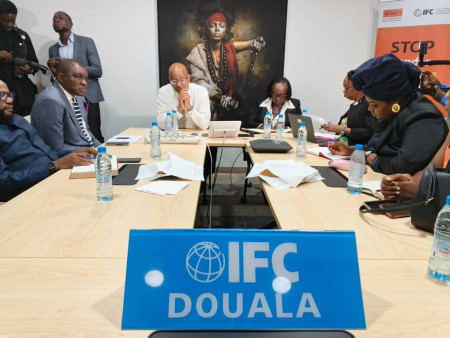
The International Finance Corporation (IFC) has renewed its commitment to supporting young entrepreneurs in Cameroon, signalling a fresh push to strengthen private-sector growth, access to finance, and job creation. The pledge was made in Douala on January 19, 2026, by Ethiopis Tafara, IFC Vice President for Africa, during a series of meetings focused on the future of financing in Central Africa and the role of youth-led enterprises in economic expansion.
Tafara’s visit formed part of a two-day tour of Cameroon’s economic capital aimed at reinforcing support for the private sector. According to the World Bank, the mission was strategic and coincided with the official inauguration of the first Credit Information Office in Central Africa (CICA), a facility expected to improve transparency and credit access for businesses. IFC officials said the institution is rolling out programmes designed to guide young enterprises towards maturity, with the objective of easing their access to financing from banks and other financial institutions.
Entrepreneurs Highlight Financing, Infrastructure and Tax Pressures
During exchanges with young entrepreneurs in Douala, participants raised several structural constraints affecting business growth. Key concerns included limited access to bank financing, high transportation costs linked to poor road infrastructure, and insufficient facilities for preserving agricultural produce such as tomatoes, fruits and vegetables. Entrepreneurs also pointed to price competition from imported goods, which they said are often cheaper than locally produced items, reducing domestic sales and weakening local value chains.
Calls were made for a review of the existing tax regime, particularly exemptions on imported goods, which participants described as detrimental to local companies. Diane Audrey Ngako, Chief Executive Officer of Omenkart, said young businesses frequently struggle to retain skilled employees due to higher salaries offered elsewhere. She also reported that around 40 per cent of produce is lost because of inadequate storage facilities, adding to operating costs and limiting expansion. Financing gaps and logistics costs were also cited as major barriers to scaling up operations.
Roland Fomuncham, Chief Executive Officer of Green House Ventures, raised concerns over what he described as uneven access to government support for young entrepreneurs, stating that some businesses receive preferential treatment while others are excluded. These issues were presented as constraints to innovation, competitiveness and employment creation in the youth-led segment of the economy.
Policy Dialogue Aimed at Investment-Friendly Reforms
Alongside meetings with entrepreneurs, the IFC held high-level consultations with public authorities, business leaders and banking officials. The discussions focused on identifying investment-friendly reforms and practical measures to stimulate innovation, growth and employment in economically constrained environments. A separate consultative session brought together private sector leaders and policymakers to establish a more regular and structured economic dialogue between government and businesses.
IFC officials said the objective is to align development policies more closely with market realities, ensuring that private sector needs are reflected in the national economic agenda. The initiative is intended to narrow gaps between policy formulation and implementation, particularly in areas affecting enterprise financing and competitiveness.
The Douala meetings come as the IFC continues to expand its footprint in Cameroon. By the end of March 2026, the institution aims to maintain a portfolio of about 169 billion CFA francs in the country. Beyond this, IFC has set an ambition to inject nearly an additional 300 billion CFA francs by 2027, targeting sectors linked to private investment, enterprise development and job creation.
The renewed engagement with young entrepreneurs and policymakers forms part of IFC’s broader strategy to strengthen Cameroon’s private sector as a driver of economic growth. The focus on credit infrastructure, dialogue with stakeholders and portfolio expansion reflects the institution’s ongoing role in shaping financing conditions and supporting business development in the country.
Mercy Fosoh

