














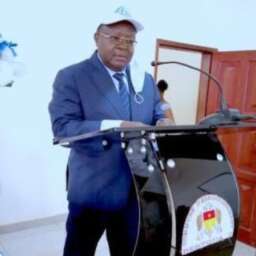



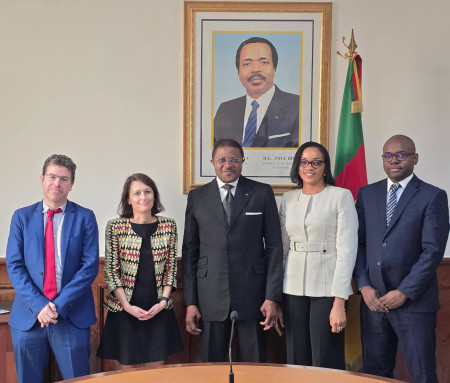
Cameroon’s Minister of Transport, Jean Ernest Masséna Ngallè Bibéhè, met with a World Bank delegation on 20 January to review progress on transport projects financed by the institution, focusing on strengthening critical infrastructure and services to support the country’s socio-economic development. The meeting, described by the Ministry of Transport (MINT) as constructive and collaborative, brought together transport stakeholders to discuss strengthening bilateral cooperation in transport infrastructure and services.
In his opening remarks, the Minister highlighted the shared objective of deepening the bilateral partnership with the World Bank to sustainably improve Cameroon’s transport infrastructure and services, thereby underpinning broader economic development. Cameroon’s economy grew by 3.5 % in 2024, with inflation at 4.5 % and overall GDP valued at about $53.3 billion according to World Bank data. Strengthening transport infrastructure forms part of broader efforts to support growth and international trade.
Review of World Bank-Supported Projects
Officials reviewed multiple ongoing programmes supported by the World Bank. On road safety initiatives, it was noted that financing under broader transport projects, including the Transport Sector Development Project (PDST), the Transport Sector Support Programme (PACRI), and facilitation for the Regional Project for Improvement of the Douala-N’Djamena Rail/Road Corridor (PCDN), continues to be channelled into activities aimed at reducing road-related hazards.
The World Bank has provided significant additional financing to the transport sector. In June 2024, the institution approved an extra $50 million for the Transport Sector Development Project to support construction and supervision of urban road works in Bamenda, thereby enhancing transport planning and safety on the Babadjou-Bamenda corridor. This increased total World Bank financing for that project to $242 million.
Detailed discussions also addressed the PCDN, which formally came into effect on 13 June 2024. The project seeks to rehabilitate parts of the existing rail infrastructure, facilitate commerce and transit along the intermodal Douala-N’Djamena corridor, and support progressive implementation of facilitation measures, including the publication of expressions of interest and first contract signings. However, both sides acknowledged that the start of some planned activities remains contingent on the completion of technical studies and procurement procedures, expected by 2026 and pledged continued cooperation to address delays and meet shared goals.
The Douala-N’Djamena corridor, which is central to trade between Cameroon and its neighbours, accounts for a significant portion of economic activity. According to project documentation, in 2026, the rail component alone is budgeted at about FCFA 11.12 billion, representing roughly 6.2% of the project’s total budget. These funds are earmarked for the rehabilitation of 238 km of rail line to boost transit efficiency and connectivity.
The transport sector remains a notable contributor to Cameroon’s economy. Data from Trading Economics indicate that the transport sector’s GDP reached FCFA 691 billion in the second quarter of 2025, up from earlier quarters, reflecting the sector’s performance in the broader economy.
Cameroon’s transport system, roads, rail and intermodal corridors play an essential role in facilitating domestic movement and regional trade. While only 8.6 % of the country’s extensive road network of some 121,873 km was paved as of the end of 2024, prompting calls for increased investment, international financing continues to target strategic routes.
Both the Minister and the World Bank delegation expressed satisfaction with the quality of existing cooperation. They reaffirmed their joint commitment to the practical and timely implementation of current and forthcoming transport projects. The meeting concluded with assurances that World Bank support will continue and that government authorities will ensure ongoing projects advance smoothly, with expected socio-economic benefits once fully realised.
Mercy Fosoh

