
























- Cameroon reduced the annual forest royalty by 25% to 35% starting January 1, 2026.
- Certified sustainable operators qualify for the highest 35% reduction.
- Undeclared timber exports cost Cameroon more than CFA170 billion between 2014 and 2017, according to NGOs.
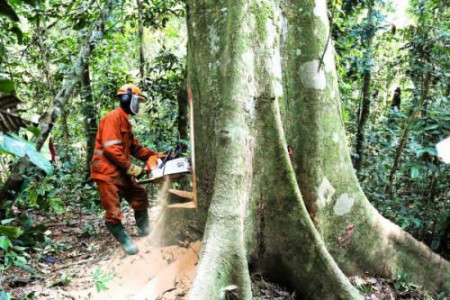
In Cameroon’s 2026 finance law, the government introduced a fiscal incentive aimed at discouraging illegal and uncontrolled logging. Starting January 1, 2026, the government applies a 25% to 35% reduction to the annual forest royalty paid by logging operators, according to a budget execution circular issued by the finance minister.
The circular defined the eligibility criteria. “Companies holding an exploitation permit receive a 25% reduction on the annual forest royalty (RFA). This rate rises to 35% for companies that demonstrate sustainable management certification,” the document stated. Finance Minister Louis Paul Motazé, who signed the text on December 31, 2025, said the RFA reduction aimed to “encourage the sustainable management of forest resources.”
This measure came as authorities faced persistent illegal logging and non-compliant practices by some licensed operators. According to several official reports, these activities generated significant economic and environmental damage. The National Financial Investigation Agency (ANIF) recalled in a 2021 report that a March 2019 letter from the minister of territorial administration called for disciplinary and criminal proceedings against individuals involved in illegal forestry and wildlife exploitation, an activity that “creates a shortfall of nearly CFA33 billion per year for the Cameroonian state.”
More Than CFA170 Billion in Losses
However, illegal logging did not represent the main source of revenue losses in the sector. Environmental NGOs said false declarations of timber volumes weighed more heavily on public finances. By underreporting production, some operators concealed part of their turnover and mechanically reduced associated tax obligations.
In a 2020 report, the Environmental Investigation Agency (EIA) and the Centre for the Environment and Development (CED) estimated that Cameroon lost more than CFA170 billion between 2014 and 2017 due to under-declared timber exports to Vietnam alone. The estimate reflected declared value gaps between exporters and importers.
The Vietnamese Example
The report titled “Stolen wood, desecrated temples: the harmful consequences of the timber trade between Cameroon and Vietnam on Cameroonian populations and forests” described a trade that contributed little to public revenue due to largely clandestine financial transactions. “The timber trade between Cameroon and Vietnam barely contributes to improving state revenues, as financial transactions are often clandestine. They take place in cash and rely on false declarations. Between 2014 and 2017, Cameroonian exporters declared $308 million less than Vietnamese importers,” the document stated.
Beyond declaration gaps, the report attributed additional violations to Vietnamese forestry operators active in Cameroon. “The exponential growth of timber trade between Cameroon and Vietnam relies on shocking schemes and illegal activities,” including “widespread violations of export laws; tax evasion, illegal logging and encroachment on protected areas; and money laundering operations covered by paperwork,” the text listed.
The authors also highlighted a rapid shift in trade flows. “In just a few years, Vietnam became the second-largest market for Cameroonian timber after China, while Cameroon became Vietnam’s leading supplier of tropical logs, accounting for 25% of imported logs between 2016 and 2019.” The report added that Cameroonian logs replaced Southeast Asian species previously used in Vietnam.
Brice R. Mbadiam

