

























Mufid Union, the umbrella body for first-category microfinance institutions operating under the Union of Development Financial Cooperatives, reported sharply improved indicators five years after its creation. Outstanding loans reached CFA36 billion in 2025, up from CFA20.5 billion in 2020, representing growth of more than 43%. Deposits followed the same upward trend, rising to CFA84 billion in September 2025 from CFA51.7 billion five years earlier.
Over the same period, capital increased from CFA6.1 billion to CFA8.9 billion, a rise of 31.4%. Total assets climbed past CFA108 billion, compared with CFA65 billion in 2020. During the period under review, Mufid Union disbursed a cumulative CFA366 billion in loans, while equity funds stood at about CFA17 billion.
Network expands nationwide
The group’s territorial footprint continued to expand. The number of operational Mufid entities rose from 91 to 95, with a total of 122 service points spread across Cameroon’s ten regions, up from 110 in 2020.
The customer base also grew steadily. Membership increased from 252,000 in 2020 to more than 363,000 as of September 30, 2025, an increase of about 30%. This expansion aligns with Mufid Union’s strategy to strengthen its position as a proximity-based microfinance player.
Return to institutional profitability
After several years of restructuring, Mufid Union highlighted an improvement in profitability. The group said one of its most notable performance indicators was the consolidation of institutional profitability, with results returning to positive territory. In 2024, Mufid Union exited losses and posted its first-ever positive net result, exceeding CFA11 million.
The return to profit came amid growth in outstanding loans and stronger capital, factors that underpin the network’s capacity to finance expansion and absorb credit risk.
New 2025–2029 roadmap
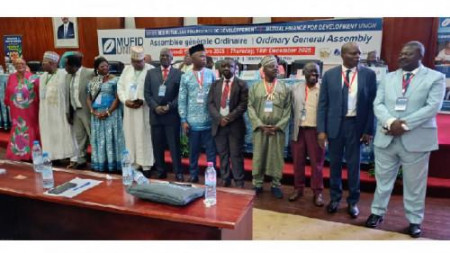
Looking ahead, Mufid Union adopted a 2025–2029 business plan, an information systems master plan, and a new policy for expanding branches in major cities. These orientations were discussed and approved during the annual general meeting held on December 18 in Yaoundé.
The meeting was also elective, with the renewal of Mufid Union’s governance bodies, including members of the board of directors and the supervisory board. These decisions set the governance framework for implementing the group’s new multi-year strategy.
New leadership and stronger rural focus
At the end of the meeting, Daniel Hamidou Haidava was elected chairman of Mufid Union’s board of directors. He previously served as chairman of the board of the Mufid in Mokolo, in the Far North region. Outgoing chairman Ally Ibrahim was appointed president of the honorary council, while former office holder Professor Paul Nkwi was named honorary president of the council.
Mufid Union reiterated its mission to drive development through wealth creation, particularly in rural areas. The network supports agropastoral development and has signed partnership agreements with the Ministry of Agriculture and Rural Development, the Cotton Development Corporation, the Cocoa and Coffee Development Fund, and the National Confederation of Cotton Producers of Cameroon. These partnerships reinforce its role as a channel for public policies supporting rural finance.
Ludovic Amara

