
























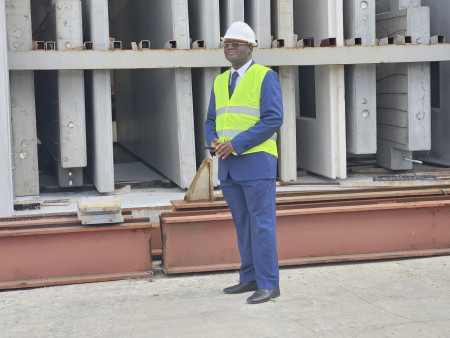
The Cameroon Real Estate Corporation (SIC) has moved its partnership with Portuguese firm A1V2 into a post-signature due-diligence phase following a working visit to Lisbon from 15 to 17 December 2025 by its Director General, Dr Ahmadou Sardaouna. The mission follows the framework agreement signed on 21 October 2025 and focuses on validating A1V2’s technical, industrial and organisational capacity, securing the scale-up of a 4,000-unit social housing programme across multiple sites in Cameroon, and preparing the industrialisation of housing through heavy and light prefabrication. The process aims to structure a long-term industrial and technological partnership aligned with national production and skills development objectives.
The Lisbon engagements reviewed priority projects in Garoua (110 and 444 housing units), Maroua (496 units) and Sangmélima (276 units). Videoconferences at A1V2’s headquarters enabled detailed assessments of remaining technical constraints on the SIC side, including DWG topographic surveys, complete geotechnical studies, demolition works in Garoua, and the stabilisation of functional programmes and overall site masterplans. This stage is intended to allow a transition to reliable execution studies, a prerequisite for controlled industrialisation. Discussions also covered architectural studies for SIC’s future headquarters, involving an international panel of architects as a flagship project of the Cameroon-Portugal partnership.
According to SIC, the visit represents a shift from a conventional real estate development model to an integrated housing-factories-skills approach. The stated objectives are to “secure public investment, guarantee technology transfer and ensure industrial and social performance,” while preparing the industrial roll-out of prefabricated housing. During site visits to OPDA/TECPONTE and VIGOBLOCO plants, the SIC delegation assessed concrete prefabrication technologies, mass production capacity, module standardisation and quality, and received proposals for establishing industrial units in Cameroon.
The industrial dimension includes projections for four to five regional production units to support nationwide delivery. Under the envisaged structure, SIC would move beyond its role as project owner to become a structuring actor in the social housing industrial value chain. The partnership also provides for the establishment of a national industrial housing base, long-term training of Cameroonian skills, and a governance framework compliant with OHADA standards and Cameroon’s 2017 law on public enterprises. This framework is intended to support the creation of housing production plants and associated Special Purpose Vehicles linked to the SIC-A1V2 programme, positioning the housing initiative within a defined industrial and investment architecture.
Mercy Fosoh

