




























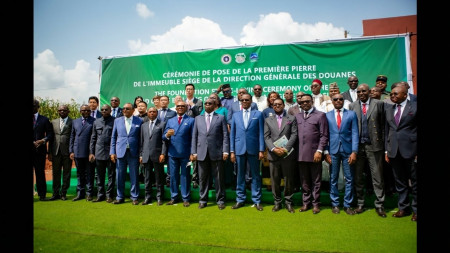
(Business in Cameroon) – While the 23 billion FCFA price tag for the new Directorate General of Customs (DGD) headquarters has dominated headlines, the strategic value of the project lies in its potential to resolve a long-standing structural inefficiency: the costly fragmentation of Cameroon’s primary revenue-generating administration.
The launch of works on December 9 marks a decisive shift in the Ministry of Finance’s asset management strategy. For years, the DGD’s central services have been scattered across multiple leased buildings in Yaoundé, creating logistical bottlenecks and significant recurrent expenditures for the state budget. By consolidating 800 staff members into a single 10,000 m² purpose-built facility, the project is designed to eliminate these rental overheads. Analysts view the 23 billion FCFA investment not merely as infrastructure spending, but as a capital expenditure (CAPEX) intended to reduce operating expenses (OPEX) over the next decade.
While Business in Cameroon correctly highlights the role of the China Machinery Engineering Corporation (CMEC) as the builder, a critical component of the project’s governance is the technical supervision. The government has mandated INTEGC, a leading Cameroonian engineering consultancy, to ensure quality control and compliance. This dual structure—Chinese execution capacity backed by local technical oversight—is key to mitigating the risks of delays and cost overruns often associated with complex state infrastructure projects. With a strict 42-month timeline targeting delivery by mid-2029, INTEGC’s role will be pivotal in enforcing the technical specifications of the 11-storey tower.
The choice of the Mballa II district (near the Unity Palace and the Golf area) is not incidental. It signals the continued migration of strategic state institutions away from the congested downtown area toward a new, secure administrative cluster. The new Customs HQ will sit in proximity to other high-security installations, reflecting the administration’s critical role in national security and border surveillance, beyond its fiscal duties.
The modernization of the DGD’s infrastructure comes at a time of record performance. With customs revenues forecasted to hit 1,136.2 billion FCFA in 2025, the administration has effectively outgrown its current facilities. The new headquarters is arguably a necessary upgrade to sustain this trillion-FCFA output, providing the digital infrastructure and secure data environments required for modern fiscal intelligence and fraud detection.
Mercy Fosoh

